Bangladesh Construction Worker Jobs with Visa Sponsorship 2026
Construction has long been one of the main routes for Bangladeshi workers seeking jobs abroad. From the building sites of the Gulf to infrastructure and housing projects in East Asia and Europe, contractors regularly recruit masons, steel fixers, carpenters, plumbers, electricians, scaffolders, painters, and general labourers from Bangladesh. Many of those employers are willing to sponsor suitable workers, which makes construction a practical option for a Bangladeshi worker who wants to work overseas in 2026.
For a Bangladeshi construction worker, visa sponsorship means a contractor or building company abroad agrees to support your work visa application, usually by providing a genuine job offer and a contract and by supplying the documents immigration authorities ask for. It does not mean the visa is guaranteed. The final decision rests with the government of the destination country, under its own rules and quotas and on the basis of your documents, so anyone promising a guaranteed visa for a large payment upfront should be treated with caution.
This article explains Bangladesh construction worker jobs with visa sponsorship in 2026 in honest, practical terms. It covers the trades in demand, what the work involves, the skills and documents employers expect, how to apply step by step, what pay and life on a construction contract look like in general terms, and the mistakes that cost good workers their chance. It does not promise a job or a visa. It gives you information you can act on.
Why Bangladeshi Construction Workers Are in Demand
Bangladeshi construction workers have a long history on overseas building sites, especially in Saudi Arabia, the United Arab Emirates, Qatar, Kuwait, Oman, and Malaysia. Generations of Bangladeshi masons, steel fixers, and labourers have worked on towers, roads, airports, and stadiums abroad. That history creates trust: contractors know what to expect, and recruitment agencies know where to find skilled workers.
Experience is the first strength. Bangladesh has a large domestic construction sector, from housing in Dhaka and Chattogram to bridges, roads, and commercial projects across the country. A mason who has built walls for five years, a steel fixer who has tied reinforcement for multi-storey buildings, or a shuttering carpenter who has worked on large slabs does not need to learn the trade from scratch. Employers value workers who can start producing good work quickly.
Trade skills are the second strength. Technical training institutes, apprenticeships, and on-the-job learning produce electricians, plumbers, welders, scaffolders, and equipment operators. A worker with a recognised trade certificate and real site experience has a clear advantage over an untrained applicant.
Adaptability is the third strength. Construction abroad often means working in extreme heat, on tall structures, in shared accommodation, and on changing shift patterns. Bangladeshi workers who adjust, turn up on time, and stay for the full contract are the ones employers ask for again. Repeat hiring is common: a contractor that had a good experience with Bangladeshi workers will request more from the same source.
Language also helps. Many Bangladeshi workers understand basic English, enough to follow safety briefings and a foreman’s instructions. In the Gulf, large South Asian communities make daily life easier, and many worksites use a mix of languages that Bangladeshi workers can navigate.
Finally, scale matters. Large projects need large numbers of workers quickly. When a contractor needs a hundred masons or fifty steel fixers for a new phase, Bangladesh is one of the few countries that can supply them. That is why recruitment drives for construction workers so often focus on Bangladesh.
Construction Trades in Demand
Construction worker is only a general label. In practice, employers abroad recruit for specific trades, and a Bangladeshi worker who knows his own trade, whether it is masonry, steel fixing, shuttering or finishing, can apply for the role that fits him rather than for every vacancy he sees.
Masons and block layers build walls, lay bricks and blocks, plaster surfaces, and finish concrete work. This is one of the most common trades recruited from Bangladesh, and experienced masons are in steady demand.
Steel fixers, known as rod binders on many Bangladeshi sites, cut steel bars to length, bend them to the drawing and tie them into cages and mats for columns, beams and slabs. The work is physically hard and demands accuracy, because the strength of a concrete building depends on its reinforcement being placed correctly.
Carpenters on construction projects mainly do shuttering and formwork, building the timber or steel moulds into which concrete is poured, then removing them once the concrete has set. In the finishing stage they also fit doors, windows and interior woodwork. Shuttering carpenters are in high demand on large projects abroad, and Bangladeshi carpenters with this skill are regularly recruited.
Construction electricians install wiring, lighting, sockets, panels and cable systems inside buildings. The work requires reading electrical drawings, following safety rules and testing each installation before handover. A trade certificate is usually expected for this role, together with site experience.
Plumbers install the water supply, drainage and sanitary systems of a building. Like electricians, they need a certificate and experience, and their work is checked carefully, because a leak behind a finished wall is costly and disruptive to put right.
Welders join steel and metal parts in structural, piping and fabrication work, and recruitment for these roles commonly includes a practical welding test. A Bangladeshi welder who passes the test with a clean, sound weld has a strong chance of selection.
Scaffolders erect and dismantle the scaffolding that other trades work from, so their work carries the weight of the whole site. It is skilled, safety-critical work done at height, and it requires specific training and a mindset that checks every fitting before anyone climbs.
Painters, tilers and plasterers handle the finishing work that a client sees first. Tilers lay floor and wall tiles, plasterers finish surfaces smooth and even, and painters prepare and coat interiors and exteriors. Because this work is visible to everyone who enters the building, quality matters a great deal for Bangladeshi finishing workers abroad.
Heavy equipment operators drive excavators, cranes, loaders and other machines on site. These roles need a licence and real experience, and they are usually better paid than general labour, because a trained operator is harder to find than a labourer.
General construction labourers support all the trades: carrying materials, mixing concrete, cleaning the site, loading and unloading deliveries and helping skilled workers. The entry requirements are lower than for a trade, but the work is physically demanding, and many Bangladeshi workers start as labourers and learn a trade from the skilled men working beside them.
The Trades Sites Need Most
Construction sites recruit for many trades at once, and demand shifts with the project in Bangladesh: formwork and steel fixing early on, bricklaying and scaffolding in the middle, and finishing trades such as plastering, painting and tiling near the end. A Construction Worker who can name the trade they actually practise, and show experience in it, will be matched faster than one who applies as a general labourer.
What Construction Work Abroad Involves
A typical day on a construction site abroad starts early for Bangladeshi workers. They are transported from their accommodation to the site, attend a short safety briefing, collect tools and protective equipment, and begin the tasks assigned by a supervisor or foreman. Work continues through the shift with scheduled breaks, and the day ends with cleaning the work area and returning tools.
Construction work abroad is physical all day long. Masons lift blocks, steel fixers carry bars, carpenters handle timber, and labourers keep materials moving. Workers stand, bend and climb through sun, wind and rain, and in the Gulf the summer heat is a serious factor, so sites schedule rest breaks and provide water and shade. In colder countries, winter work brings its own challenges. Physical fitness is not optional for a Bangladeshi construction worker; it is part of the job.
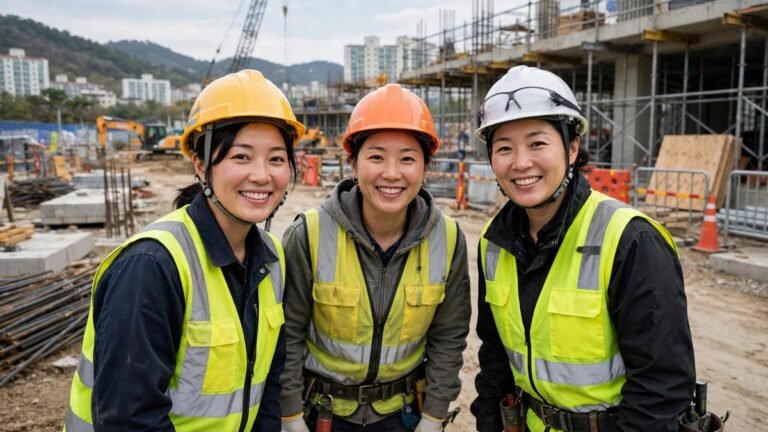
On reputable sites abroad, safety rules are strict. Helmets, safety boots, gloves, high-visibility vests and harnesses for work at height are standard equipment, and workers must attend safety inductions, follow safety officers and report hazards immediately. Ignoring the rules can lead to dismissal and, far worse, to serious injury. A good worker treats safety as part of the trade, not as an obstacle to getting the job done.
Quality is checked constantly on a well-run site abroad. Supervisors and engineers inspect work at each stage: the alignment of a wall, the spacing of reinforcement, the level of a floor, the finish of plaster. Work that fails inspection must be redone, which costs time and money, so workers who produce neat, accurate work are noticed and valued.
Hours on construction projects abroad are usually long. Tight schedules mean overtime is common, especially when a phase must be finished before an inspection or deadline, and weekend work is frequent. Before accepting an offer, a Bangladeshi worker should read the contract to understand the working hours, rest days, overtime and leave.
What You Need to Qualify
What a construction firm abroad expects from a Bangladeshi worker varies by project, but the essentials repeat from one employer to the next.
Physical fitness and health come first for a Bangladeshi construction worker heading abroad. Construction is hard physical work, and a medical examination is often part of the visa process. Good general health, the ability to work at height where the role requires it, and freedom from conditions that make heavy work unsafe are all important. Attend to any health problem before you apply.
For most construction roles abroad, trade skill and experience matter more than formal education. Employers want to know what trade a Bangladeshi worker practises, how many years he has worked in it, what types of projects he has worked on, and which tools and machines he can use. A clear, honest work history with employer names, projects and dates builds trust, while exaggerated claims are risky because a trade test will expose them quickly.
Trade certificates help a Bangladeshi construction worker’s application, especially for electricians, plumbers, welders, scaffolders and equipment operators. A technical certificate, diploma or recognised trade qualification strengthens the file. For general labourers and some mason roles, experience alone may be enough, but a certificate never hurts.
Basic English is usually expected from Bangladeshi construction workers abroad. You need to understand safety briefings, follow a foreman’s instructions, read simple signs and drawings, and report problems. Some countries require a basic English test for a work visa, and practising workplace English before you apply is cheap and effective.
Documents must be in order. A valid Bangladeshi passport with enough validity, educational and trade certificates, experience letters, a police clearance certificate where required, and photographs in the correct format are the usual set. Keep originals and copies organised so an application is not delayed.
Honesty is essential for a Bangladeshi construction applicant. Immigration authorities check backgrounds, and false documents or inflated experience can lead to refusal and future bans. Be truthful about your age, experience, health and travel history.
Your Application, Step by Step
The first move is to be clear about two things: your trade and your destination. A mason should chase mason vacancies, not electrical posts, and a steel fixer should look for steel fixing work. Then study the country itself, what rent, food and transport cost, what the weather is like through the year, and which visa route applies. A higher wage in a costly city may leave less in hand than a lower wage somewhere cheaper, so do the sums before committing.
Gather your papers well before you start applying. Check that your passport will stay valid long enough, collect trade certificates and experience letters from employers in Bangladesh, and write a short, honest CV that sets out your trade, the years you have practised it, the projects you worked on and the tools you can handle. Two pages is plenty, and the trade should be named right at the top so a recruiter spots it in the first few seconds.
Search through reliable channels: licensed recruitment agencies in Bangladesh, official job portals of the destination country, careers pages of large construction companies, and government-to-government programmes where they exist. Check an agency’s licence before paying anything or handing over original documents. Never leave your original passport with an agent indefinitely.
Send your application only to vacancies that match your own trade. A shuttering carpenter should talk about formwork and moulds, and a steel fixer should describe cutting, bending and tying reinforcement. Applications that repeat the same generic lines for every job almost never get a reply from a construction recruiter.
Go into the interview and trade test ready. The interviewer may ask which projects you worked on in Bangladesh, what tools you used there, how you would deal with a hazard on site, and how you read a drawing. Practical tests are standard in this sector, so a mason may be asked to raise a short section of wall, a welder to lay a test weld, and a steel fixer to tie a sample cage. Practise the trade in the days beforehand, turn up on time, dress neatly and carry your documents and certificates.
When an offer comes in, study the contract from start to finish before you sign it. A Bangladeshi construction worker should confirm the trade and job title, the contractor’s name, the site location, the working hours, rest days and leave, the accommodation and transport, and the notice period. Anything vague should be clarified in writing. Never put your name to a paper you have not read, and never pay a large fee until a written offer from an employer you can check is in your hands. If construction worker jobs in Bangladesh are not the right fit, garment factory worker jobs in Bangladesh follow a similar sponsorship route.
Go through the official visa process in the order the visa centre asks for it: the contractor’s sponsorship papers first, then your passport, photographs, medical results and police clearance. Turn up for biometric appointments and any interview you are called to, and keep a copy of every document you submit, on paper and on your phone, so you can show it again if it is queried. If construction worker jobs in Bangladesh are not the right fit, cleaner jobs in Bangladesh follow a similar sponsorship route.
Do not travel until the visa has actually been granted. Before leaving Bangladesh, find out the emergency numbers of your destination, the address of the nearest Bangladeshi embassy or high commission, and the basics of local worker rights. Pack your passport, visa, contract and medical papers in your hand luggage so they stay with you at every airport check.
Visa Sponsorship for Construction Workers in Bangladesh
When an employer offers a Bangladeshi construction worker sponsored work, it normally means the employer will provide the documents needed for a work visa application: a job offer, a contract, and in some countries a sponsorship certificate or labour approval. The employer may pay some government fees or arrange the application through a licensed agency. The exact arrangement varies by country, employer and contract, so read the offer and ask what is covered.
Sponsorship does not guarantee a visa for a Bangladeshi construction worker. Immigration officers decide, based on their country’s rules, quotas, labour market checks and your documents. A visa can be refused if paperwork is incomplete, if the employer fails a check, if quotas are full, or if health or character requirements are not met. No employer or agent can override that decision.
Sponsorship does not usually mean permanent residence or immediate family reunion for a Bangladeshi construction worker. Most construction work visas are temporary and tied to a specific employer and project. Changing employers generally requires a new application or permission, and whether family can join depends on the visa category and the rules in force. Do not assume dependants can travel with you.
Verify the employer before you accept a construction offer abroad. A genuine employer or contractor has a verifiable address and registration, and a written contract stating the job title, trade, place of work, working hours, rest days, leave and accommodation arrangements if any. Be cautious of offers that arrive only through messaging apps, demand large payments before an interview, or refuse to provide a written contract.
Immigration rules for construction workers do not stay still. Through 2026, governments have been revising work visa routes, closing some doors while opening others for trades in short supply, and construction is often on those shortage lists. Before a Bangladeshi worker applies anywhere, the up-to-date rules for that exact country should be checked on its official immigration website or at its embassy in Dhaka.
What Pay and Daily Life Look Like
Pay for construction workers abroad varies by trade, employer, region, and experience, and it changes with local labour laws and market conditions. No single figure applies everywhere, and any source quoting one fixed salary for all construction jobs abroad should be treated with scepticism. In general, skilled trades such as electricians, welders, and equipment operators are paid more than general labourers, and construction pay abroad is often higher than comparable pay in Bangladesh. But living costs abroad are often higher too, and deductions for accommodation, food, transport, or insurance can reduce what you save. Read the contract, understand what is included and deducted, and work out a realistic monthly budget before travelling.
Most Bangladeshi construction workers abroad live in shared housing arranged by the employer or paid for through an allowance. On big projects, particularly in the Gulf, that often means a labour camp or a shared room with other workers. Before accepting, ask exactly what is provided, whether transport between the housing and the site is included, and whether meals or a food allowance form part of the package.
Eating is a practical matter worth planning for. Rice, dal, fish and familiar spices are sold in Gulf cities and in large cities elsewhere, but they usually cost more than in Dhaka or Chattogram. Some employers serve meals on site and some do not, so check the contract, set aside a realistic food budget, and learn a few simple recipes before you travel so you can cook for yourself.
Life abroad runs on the project timetable, and during busy phases there is little free time. Most Bangladeshi workers spend their rest days sleeping, calling family and sending money home, though the time difference and rotating shifts can make a regular call hard to keep. Setting a fixed weekly call time with the family before departure makes staying in touch much easier.
On a building site abroad, safety needs attention every day, not just during induction week. Construction is one of the riskier industries, and the rules on a reputable site exist because falls, moving machinery and falling objects injure real people. Wear your helmet, boots, gloves and harness, attend every briefing, follow the safety officer’s directions, and never work at height without a harness or start a machine you have not been trained on. If you are hurt, report it straight away and get medical help. In most destination countries the law protects a worker’s right to a safe workplace, and that protection covers foreign workers as well.
What Can Go Wrong: Mistakes to Avoid
The worst mistake a Bangladeshi construction worker can make is handing a large sum to an agent without a licence who guarantees the visa. That guarantee is meaningless, because no agent decides visas. A fee far above what licensed agencies charge, no receipt for money handed over, and pressure to pay at once before a written offer from a real contractor exists are all signs to walk away from the deal.
Fake papers and inflated experience are another trap. A worker who claims years of masonry or welding he does not have will be found out at the trade test, and an immigration check that uncovers a false certificate can end in a refusal and a ban on later applications. Presenting your real experience honestly is far safer.
Many Bangladeshi construction workers lose a job simply because they turn up unprepared. Spend the days before the interview practising your trade, going over the projects you worked on, and rehearsing plain answers about the tools you used and the work you did, so you can describe your own history clearly when the recruiter asks.
Putting your name to a contract you have not read can prove costly. A spoken promise about overtime, housing or bonuses is hard to prove afterwards, while the written contract is the document an employer or labour office will go by. Before signing, check the hours, the weekly rest day, the accommodation terms and any deductions, and ask for anything unclear to be put in writing.
A last pitfall is flying out without learning about the destination. The climate may be far hotter or colder than Bangladesh, rent and food may cost much more than expected, and local rules on housing, transport and daily conduct may surprise a newcomer. A few hours of reading before departure can prevent months of hardship after arrival.
Common Questions About Construction Worker Jobs in Bangladesh
Can a Bangladeshi construction worker get a job abroad with visa sponsorship in 2026? Yes, it is possible, and many Bangladeshi workers do it every year. Employers sponsor construction workers when they cannot fill roles locally. Sponsorship depends on the employer, the country, and current visa rules, and it is never guaranteed.
Does a Bangladeshi construction worker need a trade certificate? For skilled trades such as electrician, plumber, welder and scaffolder, employers usually expect one, and a certificate from a technical institute or a BMET-recognised course helps. For mason and general labouring posts, solid site experience alone may be accepted, but a certificate still makes the application stronger.
Does a Bangladeshi construction worker need experience? In most cases, yes. Employers abroad usually look for at least a year or two of site work in the trade they are hiring for. A newcomer can sometimes find a general labouring post, but skilled roles such as shuttering, welding or scaffolding need experience that can be shown and tested.
Does a Bangladeshi construction worker need fluent English? Fluent English is rarely required. Basic working English is generally enough to understand a safety briefing, follow a foreman’s instructions and report a problem. Workers with stronger English do have an edge, especially for roles that involve reading drawings or guiding a small team.
How long does a construction work visa take for a Bangladeshi applicant? It depends on the destination country, the visa category the employer is using and how busy the processing system is at that time. Some files are decided within weeks, while others take much longer when medical or background checks are slow. Hold off on non-refundable tickets until the visa is actually granted.
Can a Bangladeshi construction worker bring his family? It depends on the visa category and the rules in force. Most construction visas are issued for the worker alone at first, and family reunion may not be possible until later, if at all. Check the specific rules for your visa type rather than assuming your family can travel with you.
What if an agent asks a Bangladeshi construction worker for a large payment upfront? Be cautious. Ask for a written breakdown of what the money covers, check that the agency holds a valid recruiting licence from BMET, and compare the fee with other licensed agencies handling construction jobs. Never pay a large sum without a written offer from an employer you can verify and a proper receipt.
Is construction work abroad safe for Bangladeshi workers? Reputable employers follow the safety laws of the country, provide induction training and supply helmets, harnesses and other protective gear. Even so, building work carries genuine risks, from falls and machinery to extreme heat, so following the rules and wearing the equipment every day is essential.
The Bottom Line for Construction Workers
Bangladesh construction worker jobs with visa sponsorship in 2026 remain a genuine opportunity for prepared, skilled, and patient workers. Demand is steady, Bangladeshi tradespeople are respected on sites around the world, and many build better lives through construction contracts abroad. But sponsorship is never a guarantee, pay varies by trade, employer, and region, and the process rewards careful preparation.
For a Bangladeshi construction worker, the journey starts with the basics: a passport and trade papers kept ready, an honest CV that names the trade at the top, skills kept sharp through practice, and enough workplace English to follow a briefing. Apply only through channels you can verify, read every contract before signing, ask questions when a term is unclear, and never pay for a guaranteed visa that no one can promise. The workers who do well abroad are usually those who prepared properly, chose a genuine employer, and arrived ready to work hard, work safely and settle into a new site. Taken step by step, a construction job overseas can become a steady foundation for a more secure future for you and your family.