USA Warehouse Associate Jobs with Visa Sponsorship 2026
Introduction
USA Warehouse Associate Jobs with Visa Sponsorship 2026 are among the most searched warehouse roles for workers from Pakistan, India, Nigeria, Kenya and other countries who want a steady job in the United States. Warehouses sit at the centre of American shopping, and every online order passes through the hands of a warehouse associate. Indeed lists 1,569 warehouse associate jobs in the USA, with pay commonly advertised at $22 to $25 per hour, and Amazon advertises warehouse pay of $23.60 per hour. That is real money for a job that does not need a university degree, and it is the reason so many people search for these roles every day.
This article gives you the honest picture. It covers what warehouse associates actually do, how much they earn, what shifts look like, what employers ask for, and how to apply. It also answers the visa question straight: most warehouse jobs in the USA do not come with visa sponsorship, and anyone who promises you a guaranteed sponsored warehouse job for a fee is almost certainly trying to scam you. There are real routes, and this article explains them, but they are limited and competitive. Read the whole article before you apply, and you will know what is real and what is not.
A Shift Inside an American Warehouse
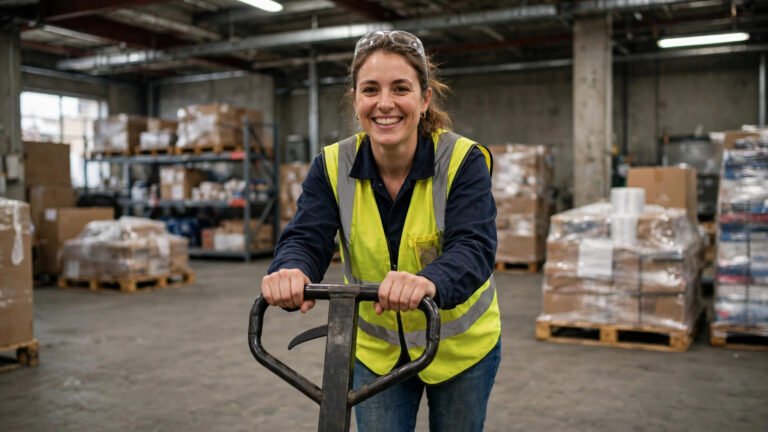
An American warehouse is a large, busy building where goods are received, stored, picked, packed and shipped. A typical warehouse associate works an 8 to 12 hour shift, and the work is physical from start to finish. You will be on your feet all day, walking several kilometres in a shift, lifting boxes, and moving between aisles. Many warehouses are air conditioned, but some are hot in summer and cold in winter, especially near the loading docks.
A shift usually starts with a short team meeting. A supervisor explains the day targets, any safety notes, and which orders are urgent. Then you go to your station. Some associates work on picking, which means walking through the aisles with a scanner, finding items on shelves, and placing them in a tote. Others work on packing, which means putting picked items into boxes, adding labels, and sealing them for shipping. Others work on receiving, unloading trucks, checking deliveries against a list, and putting stock away.
Many warehouses run 24 hours a day, so shifts cover days, evenings, nights and weekends. Night shifts often pay a little more, and overtime is common during busy periods like the weeks before Christmas. The work is repetitive, and the pace is set by targets, but most workers say the day passes quickly because there is always something to do. If you like active work and you do not mind routine, warehouse work suits you. If you want a desk job, it does not.
What You Pick, Pack and Move All Day
The exact work depends on what the warehouse stores. A warehouse that handles online retail orders will have you picking small items like clothes, books, phone chargers and toys. A warehouse that handles food will have you moving boxes of canned goods, frozen food and fresh produce, sometimes in a cold room. A warehouse that handles car parts or building materials will have heavier boxes and more use of forklifts and pallet jacks.
Most warehouse associates use a handheld scanner, which tells them what to pick and where to find it. You scan the item, scan the shelf, and place the item in the right tote. Accuracy matters as much as speed, because a wrong item means a wrong delivery and an unhappy customer. Some warehouses use voice picking, where a headset tells you what to do and you speak back to confirm. Others use conveyor belts that bring the work to you.
Forklifts, pallet jacks and reach trucks are used for heavy work, and you will need training and a licence to drive them. Many employers provide that training free after you join. Other tools are simple: box cutters, tape guns, trolleys and ladders. You will also do some paperwork, or its digital version, recording damaged items, counting stock and reporting problems. Safety is taken seriously, and every warehouse has rules about lifting, footwear, high visibility vests and keeping walkways clear.
Pay, Hours and the Benefits That Come With the Job
Pay is the first thing most job seekers ask about, so here it is plainly. Indeed lists warehouse associate pay in the USA at around $22 to $25 per hour, and Amazon advertises $23.60 per hour for warehouse roles. At $23 per hour, a 40 hour week pays about $920 before tax, which is around $3,680 a month. Overtime is usually paid at time and a half, so a 50 hour week at the same rate pays considerably more. Pay varies by state and city: warehouses in California, Washington and New York tend to pay more, but rent and living costs are also higher there.
Most large employers offer benefits on top of the hourly wage. These often include health insurance, dental and vision cover, paid time off, sick leave, and a retirement plan such as a 401k. Amazon, Walmart, Target, UPS and FedEx all offer benefits to full time warehouse workers, and some offer them from the first day. Some employers also pay for training, offer tuition help for college courses, and give employee discounts on the goods they sell.
Hours are usually full time, at 40 hours a week, with overtime available in busy seasons. Part time roles also exist, often with evening or weekend shifts, and these suit students or people with family duties. Night shifts and weekend shifts often carry a shift differential, which is extra pay per hour, usually $1 to $2. When you compare offers, look at the whole package, not just the hourly rate, because health insurance and paid leave are worth a lot of money over a year.
Who Gets Hired: Requirements and Experience
Warehouse associate jobs are open to people without a degree and often without experience. Most employers ask for a high school diploma or its equivalent, but many will hire without it if you can do the work. The main requirements are physical: you must be able to stand for a full shift, walk long distances, and lift boxes of up to 20 to 25 kilograms regularly, sometimes more with help. You also need basic English, enough to read labels, follow instructions and talk to your supervisor.
Experience helps but is not always required. If you have worked in a warehouse, a shop, a factory or a delivery job before, say so clearly on your CV, because employers value it. Experience with scanners, forklifts, inventory systems or packing is a plus. A forklift licence is an advantage, and some employers will train you and pay for the licence after you start. What employers want most is reliability: showing up on time, every day, and working steadily through the shift.
For workers from abroad, the honest truth is that most warehouse employers hire people who already have the right to work in the USA. That means a green card, a work permit, or citizenship. Employers who sponsor visas for warehouse roles are rare, and they usually do so only when they cannot fill the role locally. Your best chance is to be an honest, strong applicant with relevant experience, a clean record and a clear CV, and to apply through real company career pages rather than through agents who charge fees.
Papers, Checks and Documents to Prepare
Before you apply, get your documents ready. You will need a clear, honest CV that lists your work history, your skills and your contact details. Keep it to one or two pages, and write it in plain English. List any warehouse, factory, shop or delivery experience first, with dates, and mention any machinery you can use, such as forklifts or pallet jacks. If you have a driving licence or a forklift certificate, include it.
Employers in the USA run background checks on warehouse workers, because warehouses hold valuable goods. A criminal record does not always disqualify you, but you must be honest about it if asked. Many employers also run a drug test before you start. You will need to prove you have the right to work, which means showing a valid work authorisation document at the hiring stage. No honest employer will ask you to pay for a job offer, a visa or a work permit, and no real company charges an application fee.
Keep copies of your passport, your education certificates and any reference letters from past employers. A short reference from a supervisor who can confirm you are reliable and hard working is worth more than a long list of claims. If your documents are in another language, get a certified English translation. Having everything ready before you apply means you can respond fast when an employer replies, and speed matters in warehouse hiring.
The Visa Question, Answered Honestly
This is the section most readers came for, so here is the honest answer. USA Warehouse Associate Jobs with Visa Sponsorship 2026 exist as a search term, but real sponsored warehouse jobs are rare. Warehouse work is classed as low skilled work, and US immigration law gives employers very few ways to sponsor low skilled workers from abroad. That is the truth, and any website or agent that tells you otherwise is misleading you.
The main legal route is the H-2B visa, which lets US employers bring in temporary workers for non agricultural jobs when they cannot find enough American workers. H-2B jobs are seasonal or peak load, which fits some warehouse work, especially in busy seasons. The employer must apply for the worker, prove there is a shortage, and pay the government fees. The worker cannot apply for an H-2B visa on their own, and the visa is temporary, usually for less than a year, though it can be extended in some cases. There is also an annual cap on H-2B visas, so places are limited.
Another route is the EB-3 visa for unskilled workers, which can lead to a green card. In theory it covers warehouse work, but in practice very few employers use it for warehouse roles because the process takes years and costs the employer a lot of money. Some workers come through other routes, such as asylum, family sponsorship or a spouse visa, and then take warehouse jobs once they have work authorisation. That is how many immigrants end up in warehouse work, not through a warehouse job offer that sponsored their visa.
Be very careful with agents. A real employer will never ask you to pay for a job offer, and a real visa process is handled through the US government, not through a WhatsApp agent who wants money in advance. Check any job on the company own career page, and check the visa rules on the official US government website uscis.gov. If an offer sounds too easy, it is almost certainly a scam.
Applying Step by Step Without Paying an Agent
Start with the real job boards and company career pages. Search Indeed, LinkedIn and Glassdoor for warehouse associate jobs, and apply directly on the websites of large employers like Amazon, Walmart, Target, UPS, FedEx, Home Depot and Costco. These companies have a careers page where you can create a profile, upload your CV and apply in a few minutes. Indeed lists 1,569 warehouse associate jobs, and that number changes daily, so check often and apply quickly when a new listing appears.
When you apply, read the job description carefully and match your CV to it. If the listing mentions picking, packing or forklifts, and you have done that work, make sure your CV says so in the first few lines. Write a short cover note that says who you are, what experience you have, and that you are ready to work full time shifts including nights and weekends if needed. Employers notice applicants who are flexible about shifts.
If you are outside the USA, be honest about your visa status in your application. Do not claim you have work authorisation if you do not, because the background check will find out and you will lose the offer. If you already have the right to work in the USA, say so clearly, because that puts you ahead of many applicants. After you apply, check your email every day, answer phone calls from unknown numbers politely, and be ready for a short phone interview followed by an in person interview or a hiring event. Large warehouses often hire in groups and can offer a job within a week of applying.
Which States and Cities Have the Most Warehouse Jobs
Warehouse jobs are not spread evenly across the USA. The biggest hubs are in California, Texas, Pennsylvania, Ohio, Illinois and New Jersey. The Inland Empire in Southern California, around the cities of Riverside and San Bernardino, has one of the largest clusters of warehouses in the world, because goods arrive at the ports of Los Angeles and Long Beach and are stored and sorted there before going across the country. Dallas and Fort Worth in Texas, Columbus in Ohio, and the Lehigh Valley in Pennsylvania are other major hubs, and each of them has thousands of warehouse jobs.
When you choose where to apply, think about rent as well as pay. California warehouses pay some of the highest hourly rates in the country, but rent in the Inland Empire can be $1,500 a month or more for a one bedroom apartment. Texas and Ohio pay a little less per hour, but rent is often $900 to $1,200 a month, so your money goes further. New Jersey warehouses pay well and sit close to New York City, but housing costs are high there too. A smart approach is to compare the hourly rate with the cost of a room or an apartment in the same town, and to look for employers that offer help with housing or transport.
Smaller towns near warehouse hubs can be a good choice for new arrivals. They are quieter, cheaper and often have a community of workers from your own country. Ask in online groups and forums where other warehouse workers from Pakistan, India, Nigeria or Kenya live, and what they pay for rent. The best city for you is the one where the pay covers the rent, the commute is short, and there are other warehouse jobs nearby if your first job does not work out.
Scams to Watch For
Warehouse job scams target workers from South Asia and Africa more than almost any other group, so learn the warning signs. The biggest one is a fee: if anyone asks you to pay for a job offer, a visa, a work permit, a medical test arranged by them, or a training course before you start, walk away. Real employers pay for recruitment, not the worker.
Other warning signs include a job offer that arrives without an interview, an email address that is not from the company own domain, a recruiter who only talks on WhatsApp or Telegram, and a contract that promises a salary far above the normal rate. A warehouse job paying $22 to $25 per hour is normal. A warehouse job promising $50 per hour with free housing, free flights and a guaranteed visa is not real. Always check the company website, call the company through the number on its own website, and never send your passport or money to a stranger.
What a Good Warehouse CV Looks Like
A good warehouse CV is short, honest and easy to scan. Start with your name, phone number and email at the top, then a two line summary that says what you are: an experienced warehouse worker, a reliable picker and packer, or a hard working newcomer ready for full time shifts. After that, list your work history with the most recent job first, giving the employer name, the dates, and three or four bullet points about what you did each day. Use numbers where you can, such as the number of orders you picked per shift or the weight you lifted, because numbers make your experience feel real.
Add a short skills section that lists the tools and systems you know, such as handheld scanners, pallet jacks, forklifts, conveyor systems and inventory software. If you have a forklift licence, a food hygiene certificate or a safety training certificate, list it with the date. Finish with your education and two references, or a line saying references are available on request. Keep the whole CV to one page if you can, and check the spelling carefully, because a CV full of mistakes tells an employer you will not check labels carefully either. Save it as a PDF with your name in the file name, so it is easy for a hiring manager to find.
Living and Working in the USA
Life as a warehouse worker in the USA is busy but stable. Most warehouse workers live in towns near large distribution centres, where rent is lower than in big cities. A one bedroom apartment near a warehouse hub can cost $800 to $1,500 a month depending on the state, and many workers share housing to save money. Public transport is limited in warehouse areas, so many workers buy a cheap car after a few months, or share rides with colleagues.
Food, transport and health care are the main costs to plan for. Cooking at home saves a lot of money, and most towns have shops selling South Asian and African food. Health insurance through your employer is a big benefit, so ask about it when you are offered a job. After a year or two of warehouse work, many workers move up to team leader, supervisor, forklift driver or inventory roles, which pay more and involve less lifting. Warehouse work can be the first step, not the last one.
Questions Job Seekers Ask
How much do warehouse associates earn in the USA?
Most warehouse associate jobs pay between $22 and $25 per hour, according to Indeed listings, and Amazon advertises $23.60 per hour. At 40 hours a week, that is about $3,500 to $4,000 a month before tax, and overtime can add more. Pay is higher in expensive states and lower in cheaper ones.
Do I need experience to get a warehouse job in the USA?
No, many warehouse jobs need no experience, and employers provide training. Experience in a warehouse, factory or shop helps your application, and a forklift licence is a plus. What matters most is being physically fit, reliable and ready to work shifts.
Can I get a USA warehouse job with visa sponsorship?
It is possible but rare. The main route is the H-2B temporary work visa, which an employer must apply for, and there is an annual cap. The EB-3 route exists in theory but is slow and rarely used for warehouse roles. Most warehouse workers in the USA already have the right to work when they are hired. Never pay an agent who promises a guaranteed sponsored job.
Which companies hire the most warehouse associates?
Amazon, Walmart, Target, UPS, FedEx, Home Depot, Costco and large logistics companies hire the most warehouse associates. Check their own career pages as well as Indeed, because new listings appear every day and early applicants have the best chance.
Is warehouse work hard on the body?
Yes, it is physical work. You will walk several kilometres a day, stand for long hours and lift boxes regularly. Good footwear, proper lifting technique and regular breaks help a lot. Most workers get used to the pace within a few weeks, and the work keeps you fit.
One last point is worth repeating. The fastest way into a warehouse job is to apply directly, apply early, and be ready to start at once. Employers hire in groups, and the people who answer the phone, turn up for the interview and pass the checks are the people who get the job. Keep your CV ready, keep your phone charged, and check your email every morning. The job is there, and the pay is real. What you do next decides whether it is yours.
Final Word
USA Warehouse Associate Jobs with Visa Sponsorship 2026 offer a real path to steady work and a decent wage in the United States, but only if you go in with your eyes open. The jobs are real, the pay of $22 to $25 per hour is real, and large employers are hiring. The visa sponsorship part is the hard part, and it is rare, slow and controlled by the employer and the government, not by an agent on WhatsApp. Apply directly to real companies, keep your documents ready, be honest about your status, and never pay for a job offer. If you already have the right to work in the USA, apply today, because warehouse hiring moves fast and the best shifts go to the first good applicants. If you are still abroad, focus on the legal routes, build your experience, and treat any promise of a guaranteed sponsored job as a scam until a real employer proves otherwise.