Top 20 Animals That Start With K
Introduction
Top 20 Animals That Start With K is a journey across the whole planet, from the red deserts of Australia to the ice filled seas of Antarctica, from the cloud forests of New Guinea to the alpine meadows of New Zealand. The letter K holds some of the most famous animals in the world, including the kangaroo, the koala and the Komodo dragon, and it also holds some of the least known, including the kagu of New Caledonia and the kakapo of New Zealand, a parrot that cannot fly and only comes out at night. This list brings all twenty together, and it is organised so that you can see not just what each animal is, but where it lives and how it survives there.
Each entry gives you the animal’s size, its home, its food, and the fact that makes it unforgettable. Some of these animals are record breakers. The red kangaroo is the largest marsupial on Earth. The king cobra is the longest venomous snake in the world. The killer whale is the largest member of the dolphin family. The Japanese spider crab holds the leg span record in the J list, but the K list has its own giants, and the krill, one of the smallest animals here, feeds the largest animals that have ever lived. After the twenty entries, there is a section that groups the animals by habitat, so you can see which ones share a home and how they survive in it, plus answers to the questions people ask most often about K animals.
A note on the names before we begin. “Killer whale” is the common name for the orca, and it is not a whale at all, it is a dolphin. “Koala bear” is a nickname, and the koala is not a bear, it is a marsupial. “Kangaroo rat” is not a rat, and “kingfisher” is not a fisher of kings. Common names are often misleading, and the scientific names in each entry tell you the true family each animal belongs to. Conservation status follows the IUCN Red List, and population figures are the most widely reported recent estimates.
1. Red Kangaroo
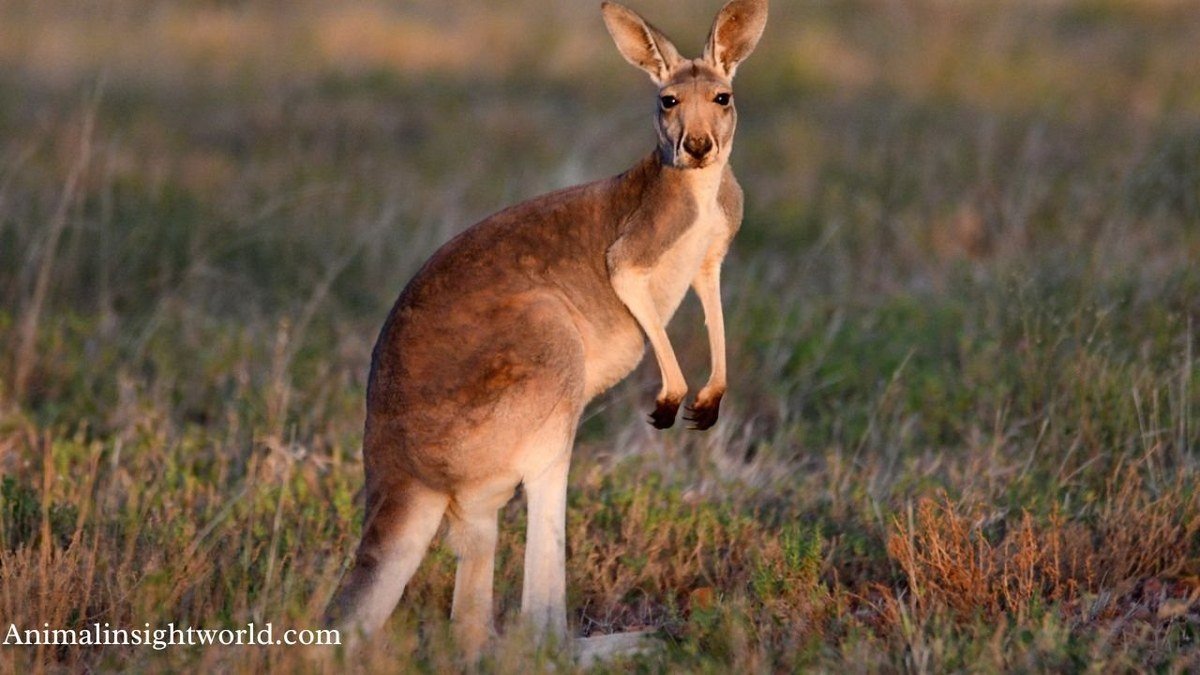
The red kangaroo is the largest marsupial in the world and the most famous animal of Australia. Its scientific name is Osphranter rufus, and a large male can stand 2 metres tall and weigh up to 90 kilograms, although most adults are smaller, at 25 to 70 kilograms for males and 18 to 40 kilograms for females. The male’s fur is a rich rusty red, the female’s is blue grey, and both have a long, thick tail that acts as a balance and as a fifth limb when they move slowly. The red kangaroo is listed as Least Concern, and it is one of the most numerous large wild animals in Australia.
Kangaroos move by hopping, and the red kangaroo is the fastest hopper of them all. It can cruise at 25 kilometres per hour and sprint at 64 kilometres per hour in short bursts, covering up to 9 metres in a single bound. Hopping is very efficient, because the tendons in the legs store energy like springs, and a kangaroo uses less energy the faster it hops. At slow speeds it uses its tail as a tripod, leaning on it while it moves its hind feet forward, which is the only way a large kangaroo can walk. Red kangaroos live in the dry interior of Australia, in open grassland and scrub, where they graze on grasses and shrubs and can go for weeks without drinking water.
A baby kangaroo, called a joey, is born after only about 33 days of pregnancy, at the size of a jelly bean, and it crawls into its mother’s pouch, where it stays for about eight months. Even after it leaves the pouch, the joey returns to suckle for several more months. Male red kangaroos fight for dominance by boxing, standing upright and grappling with their forearms while kicking with their hind feet, which is where the nickname “boxing kangaroo” comes from. In the wild, red kangaroos live for about 10 to 12 years, and in captivity they can live for more than 20 years.
2. Koala
The koala is the sleepiest animal on this list, and it has good reason to be tired, because its food is almost pure poison. Koalas eat almost nothing but eucalyptus leaves, which are low in nutrients, high in fibre, and full of chemicals that are toxic to most animals. The koala has a huge liver and a very long gut that detoxify the leaves, but digesting them still takes so much energy that a koala sleeps for 18 to 20 hours a day. An adult koala weighs about 6 to 12 kilograms and is about 60 to 85 centimetres long, with a large head, a big black nose, fluffy ears and no visible tail.
Koalas are marsupials, which means their babies are born very small and grow up in a pouch. The pouch of a koala opens towards the rear, which seems odd until you realise it stops dirt and leaves falling in while the mother climbs. A joey stays in the pouch for about six months, then rides on its mother’s back or belly for another six months. Koalas live alone in eucalyptus trees, and each animal has a home range of several trees that it marks with scent. Males make a deep bellowing call during the breeding season, and the sound is so low that it seems to come from an animal much larger than a koala.
The koala is listed as Endangered in Queensland, New South Wales and the Australian Capital Territory, after a formal listing in 2022, because its numbers fell sharply from habitat loss, disease, drought and the bushfires of 2019 and 2020. In Victoria and South Australia it is still listed as Vulnerable. The main threats are the clearing of eucalyptus forest for housing and farms, car strikes, dog attacks, and chlamydia, a disease that can cause blindness and infertility. Planting eucalyptus corridors between forest patches is one of the most practical ways to help koalas, because it lets them move safely between trees without coming down to the ground.
3. Komodo Dragon
The Komodo dragon is the largest lizard in the world, and it is a predator that hunts animals much bigger than itself. It lives only on a few Indonesian islands, mainly Komodo, Rinca, Flores and Padar, and an adult male can grow to 3 metres long and weigh about 70 kilograms, although most are smaller, at 2 to 2.5 metres and 40 to 60 kilograms. Its skin is grey brown and armoured with small bony plates, its tongue is yellow and forked like a snake’s, and its teeth are serrated like a shark’s. The species is listed as Endangered on the IUCN Red List.
For many years people believed that Komodo dragons killed with bacteria in their saliva, but research has shown that they are venomous. They have venom glands in their lower jaw that prevent blood from clotting, so a bite causes a prey animal to bleed and go into shock. A Komodo dragon can smell carrion from up to 10 kilometres away, using its forked tongue to taste the air, and it can run at 20 kilometres per hour in a short sprint. It eats deer, pigs, water buffalo and smaller lizards, and it will also scavenge dead animals. Young dragons climb trees to escape being eaten by adults, and they stay in the trees for their first few years.
Komodo dragons are solitary, and they meet mainly to mate or to feed on a large carcass. A female lays about 20 to 30 eggs in a burrow, and the eggs hatch after about eight months. Female Komodo dragons can reproduce without a male, a process called parthenogenesis, which has been recorded in zoos and is a useful trick for a species that lives on small islands. The biggest threats to the Komodo dragon are the loss of its prey, disturbance of its nesting sites, and rising sea levels, which could flood the low lying beaches where it nests.
4. King Cobra
The king cobra is the longest venomous snake in the world, and it is the only snake that builds a nest for its eggs. Its scientific name is Ophiophagus hannah, which means “snake eater”, and that is exactly what it does, because it hunts other snakes, including other cobras, pythons and rat snakes. An adult king cobra is usually 3 to 4 metres long, and the largest ever recorded was 5.5 metres. It weighs about 6 kilograms on average. It lives in the forests of South and Southeast Asia, from India to the Philippines, and it is listed as Vulnerable on the IUCN Red List.
The king cobra is famous for its hood, which it spreads when it is threatened, and for its ability to rear up to a third of its body length, which means a large king cobra can look a standing person in the eye. Its venom attacks the nervous system, and a single bite can kill an elephant, although king cobras are shy and prefer to escape rather than fight. They will only bite when they are cornered, and they often give a warning first, with a loud hiss that sounds more like a dog’s growl than a snake’s hiss. They are active during the day, and they are strong swimmers and good climbers.
Unlike most snakes, the female king cobra builds a nest of leaves and vegetation, lays 20 to 40 eggs in it, and stays to guard them until they hatch, which takes about two to three months. She does not eat during this time, and she leaves just before the eggs hatch, because newborn king cobras are venomous from birth and she might mistake them for food. In many parts of Asia the king cobra is respected and feared, and it appears in folk tales and religious stories. Its main threats are the loss of forest habitat and the collection of snakes for the pet trade, for traditional medicine and for their skin.
5. Laughing Kookaburra
The laughing kookaburra is the bird with the loudest laugh in the animal kingdom, and its call sounds so much like human laughter that early European settlers in Australia thought the bush was full of laughing people. Its scientific name is Dacelo novaeguineae, and it is the largest member of the kingfisher family, weighing about 400 to 500 grams and measuring about 45 centimetres long. It has a white head with a dark eye stripe, a mottled brown and white body, and a blue speckled rump. It lives in eastern mainland Australia, and it has been introduced to New Zealand and Western Australia, where it is now common.
Kookaburras live in family groups, and the whole family joins in the dawn and dusk chorus, which marks the boundaries of their territory. Young kookaburras from earlier years stay with their parents to help raise the next brood, bringing food to the nestlings and guarding the nest. A kookaburra’s diet is mostly meat, and it eats snakes, lizards, mice, insects and small birds, killing its prey by dropping it onto a hard surface or beating it against a branch. It does not need water to drink, because it gets enough moisture from its food, which helps it survive in dry country.
Despite its fierce hunting, the kookaburra is a popular garden bird in Australia, and many people feed it scraps of meat, although wildlife experts advise against it, because raw meat can spread disease and human food is not a healthy diet for a wild bird. The kookaburra is listed as Least Concern, and its numbers are stable, although it suffers from the same threats as other Australian birds, including habitat loss and poisoning from pesticides. In Aboriginal stories the kookaburra’s laugh is said to mark the start of the day, and some stories say its call wakes the sun.
6. Kiwi
The kiwi is a bird that cannot fly, has feathers like hair, and lays an egg so large that it would be like a human mother giving birth to a four year old child. There are five species of kiwi, all of them living only in New Zealand, and they are the national bird of the country, so much so that New Zealanders call themselves Kiwis. A brown kiwi weighs about 2 to 3 kilograms and is about 40 centimetres tall, with a long, curved beak, tiny wings hidden under its feathers, and strong legs. Kiwis are nocturnal, and they are listed as Vulnerable or Endangered depending on the species.
The kiwi is the only bird with nostrils at the tip of its beak, and it uses its superb sense of smell to find worms, insects and berries in the leaf litter at night, probing the soil with its long beak. Its egg is about 20 percent of the female’s body weight, which is the largest egg relative to body size of any bird in the world. The male does most of the incubating, sitting on the egg for 70 to 80 days, which is an extremely long time for a bird. When the chick hatches, it is covered in feathers and can feed itself within a few days, although it stays near its parents for several weeks.
Kiwis are in trouble because of introduced predators, especially stoats, rats and dogs, which kill eggs, chicks and adults. Before humans arrived in New Zealand, there were no land mammals except bats, so kiwis evolved without defences against mammalian predators. Conservation groups now protect kiwis with predator free islands, trapping programmes, and a method called Operation Nest Egg, in which eggs are collected, hatched in captivity, and the young birds are released once they are big enough to defend themselves. The programme has saved thousands of kiwis, and it is one of New Zealand’s most successful conservation stories.
7. Killer Whale
The killer whale, also called the orca, is the largest member of the dolphin family and one of the most powerful predators in the ocean. Its scientific name is Orcinus orca, and a large male can grow to 9 metres long and weigh up to 6 tonnes, while females are smaller, at up to 7 metres and 4 tonnes. Its black and white pattern is unmistakable, with a white patch above each eye, a white belly, and a tall dorsal fin that can be 1.8 metres high in males. Killer whales live in every ocean in the world, from the Arctic to the Antarctic, and they are listed as Data Deficient by the IUCN, because scientists believe there may be several different species currently grouped under one name.
Killer whales are apex predators, which means nothing hunts them, and they eat fish, seals, sea lions, dolphins, sharks and even large whales. Different groups, called pods, specialise in different prey, and they have their own hunting methods and their own calls, which are so distinct that researchers can identify a pod by sound alone. Some pods hunt seals by creating waves that wash them off ice floes, and others hunt fish by herding them into tight balls. Killer whales are also one of the few animals that hunt in coordinated groups, with different animals taking different roles in the hunt, like a team.
A killer whale pod is usually a family group led by the oldest female, and the animals stay with their mothers for life, which is unusual among mammals. Calves are born after a pregnancy of about 17 months, and they stay close to their mothers for several years. Killer whales can live for a long time, with females living for 50 to 80 years and sometimes more than 90 years. In captivity, killer whales have a much shorter life and a troubled history, and most countries have now stopped keeping them in tanks. In the wild, their main threats are pollution, noise from ships, and the decline of their prey, especially salmon in the Pacific Northwest.
8. Kinkajou
The kinkajou is a rainforest mammal that lives its whole life in the trees and almost never comes down to the ground. It is also called the honey bear, because it loves honey and has a long, thin tongue that can reach 13 centimetres out of its mouth to lick nectar from flowers and honey from hives. An adult kinkajou weighs about 2 to 4.5 kilograms and is about 40 to 60 centimetres long in the body, with a prehensile tail of similar length that can grip branches like a fifth hand. It lives in the rainforests of Central and South America, from Mexico to Brazil, and it is listed as Least Concern.
Kinkajous are nocturnal, and they spend the night moving through the canopy, eating fruit, nectar, flowers and insects, and occasionally small animals. They are important pollinators, because as they drink nectar they carry pollen from flower to flower on their faces. Their large eyes give them excellent night vision, and their sharp claws and flexible ankles let them run along branches and even hang upside down. During the day they sleep curled up in a tree hollow, often with several kinkajous sharing the same den.
A female kinkajou usually has one or two babies, which are born with their eyes closed and stay with their mother for several months. Kinkajous are sometimes kept as pets, because they are small and cute, but they are wild animals with sharp teeth and claws, and they do not make good pets. In the wild their main threat is the loss of rainforest, because a kinkajou that cannot travel through the canopy cannot find food or mates. Protecting connected forest is essential for kinkajous, and for the many other animals that share their trees.
9. Kakapo
The kakapo is the strangest parrot in the world. It cannot fly, it only comes out at night, it smells sweetly of honey and flowers, and it is the heaviest parrot on Earth, weighing 2 to 4 kilograms. Its scientific name is Strigops habroptilus, and it lives only in New Zealand, where it is called the night parrot by the Maori name kakapo, which means “night parrot”. Its feathers are mossy green with black markings, which camouflage it perfectly among the ferns and mosses of the forest floor. The species is listed as Critically Endangered, and fewer than 300 birds remain.
The kakapo is a lek breeder, which means the males gather in a special area, dig shallow bowls in the ground, and call for hours each night with a deep booming sound that can travel for kilometres. Females visit the males, choose a mate, and then raise the chicks alone. Kakapos only breed in years when the rimu tree produces a heavy crop of fruit, which may happen only once every two to four years, so the population grows very slowly. A female lays one to four eggs in a burrow or hollow, and the chicks stay with her for about three months.
The kakapo was almost wiped out by introduced predators, especially rats, stoats and cats, and by the time conservationists acted in the 1980s, only about 50 birds were left, and almost all of them were males. Every surviving kakapo has now been moved to predator free islands, where rangers monitor each bird by name, with radio transmitters and nest cameras. Each bird has a name, and the public can follow their stories, which has made the kakapo one of the most loved birds in the world. In 2019 the population passed 200 birds for the first time in decades, and the recovery continues, one chick at a time.
10. Kingfisher
The common kingfisher is a small, brightly coloured bird that hunts fish by diving from a perch, and it is one of the most beautiful birds in Europe and Asia. It weighs only about 35 to 40 grams and is about 16 centimetres long, with a bright blue back, an orange belly, a white throat and a long, dagger like beak. It lives along rivers, streams, lakes and coasts, from Europe across Asia to Australia, and it is listed as Least Concern, although its numbers fall sharply after hard winters when the water freezes.
A kingfisher hunts by sitting on a low branch over clear water and watching for fish, then diving head first with its wings folded, entering the water with barely a splash. It can adjust for the bending of light in water, which means it aims below where the fish appears to be, and it catches its prey with great accuracy. After the dive it returns to its perch, beats the fish against the branch to stun it, and swallows it head first. A kingfisher needs to eat about 60 percent of its body weight in fish every day, which means it must catch a fish every hour or two.
Kingfishers nest in burrows dug into riverbanks, and a pair can dig a tunnel up to a metre long, ending in a chamber where the female lays 6 to 7 eggs. Both parents feed the chicks, which leave the nest after about four weeks. The kingfisher’s bright colours come from the structure of its feathers rather than from pigment, which is why the blue looks different in different lights. The bird’s shape has even inspired engineering, because the front of Japan’s Shinkansen bullet train was redesigned to copy the kingfisher’s beak, which reduced the noise when the train left a tunnel.
11. Krill
Krill are tiny, shrimp like animals that form the largest mass of animal life in the ocean, and they feed almost everything that lives in the Southern Ocean. Antarctic krill, Euphausia superba, is the best known species, and an adult is about 6 centimetres long and weighs about 2 grams. A single krill is small, but there are so many of them that their total weight is estimated at around 400 million tonnes, which is more than the weight of all the humans on Earth put together. They live in the cold waters around Antarctica, in swarms that can be kilometres across and contain millions of animals.
Krill eat tiny algae called phytoplankton, which they filter from the water with their feathery legs, and they are eaten in turn by whales, seals, penguins, squid and fish. A blue whale, the largest animal that has ever lived, can eat up to 4 tonnes of krill in a single day during the feeding season. Krill are also important because they carry carbon from the surface to the deep ocean in their droppings, which helps to slow climate change. They glow in the dark, because they have organs that produce a blue light, which may help them to hide from predators or to communicate with each other.
Krill are fished commercially, mainly for omega 3 oil and for animal feed, and the fishery is managed by an international agreement that limits the catch to protect the animals that depend on krill. The bigger threat to krill is climate change, because krill depend on sea ice, and the young krill feed on the algae that grows under the ice. As the sea ice shrinks, krill numbers fall, and that affects every animal that eats them, from penguins to whales. Protecting krill means protecting the whole Antarctic food web.
12. Greater Kudu
The greater kudu is one of the most handsome antelopes in Africa, with a grey brown coat, white stripes down its sides, and magnificent spiral horns that can grow to 1.8 metres long. Only the males have horns, and they use them in fights with other males, locking horns and pushing until one gives way. A male greater kudu weighs about 200 to 300 kilograms and stands about 1.5 metres at the shoulder, while females are smaller, at 120 to 210 kilograms, and have no horns but have the same striped coat. The species lives across eastern and southern Africa, in woodland and bush, and it is listed as Least Concern.
Kudus are shy animals that hide in thick bush during the day and come out to feed in the early morning and late evening. They eat leaves, shoots, fruit and flowers, and they can go for long periods without drinking water, getting most of their moisture from their food. Despite their size, kudus are excellent jumpers, and they can clear fences 3 metres high when they are startled. Their striped coat breaks up their outline in the dappled light of the bush, which makes them very hard to spot even when they are standing still.
Female kudus live in small groups with their young, while males live alone or in small bachelor groups, joining the females only in the breeding season. A female gives birth to a single calf, which she hides in thick bush for the first weeks of its life, visiting it only to feed it. Kudus are hunted by lions, leopards and wild dogs, and by people for their meat and their horns, which are prized as trophies. Their numbers are stable in protected areas, but they are declining where their bush habitat is cleared for farms.
13. Kangaroo Rat
The kangaroo rat is a desert rodent that never needs to drink water, not once in its whole life. It lives in the deserts of North America, from Canada to Mexico, and it gets all the water it needs from the seeds it eats, which it stores in its cheek pouches and carries back to its burrow. An adult kangaroo rat weighs about 70 to 170 grams depending on the species, and it has huge hind legs, a long tail, and large eyes for seeing at night. There are about 20 species, and the most common is Ord’s kangaroo rat, which lives across the Great Plains.
Kangaroo rats are named for their hopping, which looks just like a tiny kangaroo. They can jump up to 3 metres in a single bound to escape a predator, and they use their long tail for balance, like a tightrope walker’s pole. They are nocturnal, spending the day in a cool burrow and coming out at night to collect seeds, which they bury in caches around their territory. They remember where they buried them, and a single kangaroo rat can store several kilograms of seeds over a summer. Their kidneys are so efficient that they produce almost no urine, which is how they survive in a desert where it may not rain for months.
Kangaroo rats are an important food for owls, snakes, coyotes and foxes, and they are also important seed spreaders, because the seeds they forget grow into new plants. Some species are in trouble, including the giant kangaroo rat of California, which is listed as Endangered because its grassland habitat has been ploughed for farming. The kangaroo rat is a good example of how a small animal can be perfectly adapted to a harsh place, and how quickly that adaptation can become useless when the habitat changes.
14. Kea
The kea is the world’s only alpine parrot, and it is also one of the most intelligent birds on Earth. It lives only in the mountains of New Zealand’s South Island, in beech forest and alpine scrub between 600 and 2,000 metres above sea level. An adult kea weighs about 800 grams to 1 kilogram and is about 48 centimetres long, with olive green feathers, orange underwings, and a long, curved beak. The species is listed as Endangered, and its population is estimated at only 3,000 to 7,000 birds.
Keas are famous for their curiosity and their problem solving. They have been filmed working together to solve puzzles, using tools, and playing with snow, and they are known for investigating cars in mountain car parks, where they pull off windscreen wipers and rubber seals. This behaviour makes them unpopular with some people, but it is a sign of their intelligence, not malice. Keas eat plants, seeds, fruit, insects and carrion, and they are one of the few parrots that will eat meat. In winter they play in the snow, sliding down slopes and tossing snowballs, which is play for its own sake, a rare thing in the animal kingdom.
The kea’s intelligence has not saved it from decline. Its main threats are introduced predators, especially stoats and possums, which eat its eggs and chicks, and lead poisoning, because keas chew on the lead nails and flashings of mountain huts and absorb the poison. Conservationists now replace lead fittings in the mountains, trap predators around nesting sites, and protect the kea’s forest home. The kea is a national treasure in New Zealand, and losing it would mean losing one of the smartest birds in the world.
15. Common Kestrel
The common kestrel is a small falcon that can hover in mid air like a helicopter, and it is one of the most widespread birds of prey in the world. It lives across Europe, Asia and Africa, in open country, farmland, moorland and even cities, where it nests on buildings and hunts over parks and railway lines. An adult kestrel weighs about 150 to 300 grams, with females larger than males, and it has a wingspan of about 75 centimetres. The male has a blue grey head and tail and a chestnut back with black spots, while the female is browner all over. The species is listed as Least Concern.
A kestrel hunts by hovering, facing into the wind and beating its wings rapidly while its head stays perfectly still, scanning the ground for voles, mice and insects. Its eyesight is extraordinary, and it can see ultraviolet light, which lets it follow the urine trails of voles, because vole urine reflects ultraviolet light. When it spots prey, it drops like a stone, folding its wings at the last moment to strike. A kestrel can also hunt from a perch, and it will eat insects, lizards and small birds when voles are scarce. It needs to eat about a fifth of its body weight every day.
Kestrels nest in old crow nests, in holes in trees and cliffs, and in nest boxes put up by conservationists. The female lays 4 to 5 eggs, and both parents feed the chicks, which leave the nest after about a month. Kestrel numbers fell sharply in the 1950s and 1960s because of pesticides, which thinned their eggshells, but they recovered after the chemicals were banned. Today their numbers are stable in most places, although they are declining in some areas where farming has removed the rough grassland that voles need.
16. Koi
Koi are ornamental carp that have been bred for colour for more than two hundred years, and they are living art. They come from Japan, where farmers in the Niigata region first bred common carp for their colours in the 1820s, and today a single prize winning koi can sell for more than a million dollars. The most famous sale was a red and white koi called S Legend, which sold for about 1.8 million dollars in 2018. Koi are usually 60 to 90 centimetres long and weigh 5 to 10 kilograms, although some grow larger, and they can live for 25 to 35 years in a well kept pond.
Koi are judged by their colour, pattern, body shape and movement, and there are many named varieties, including Kohaku, which is white with red markings, Sanke, which is white with red and black, and Showa, which is black with red and white. Koi are social fish that recognise the person who feeds them, and they will come to the surface and take food from a hand. They eat pellets, vegetables, fruit and insects, and they need clean, oxygen rich water with plenty of space, because a crowded pond makes them sick.
In Japan, koi are a symbol of good luck, perseverance and strength, because wild carp swim upstream against strong currents. Koi ponds are a feature of Japanese gardens, and the fish are often kept for decades, passed down from one generation to the next. The oldest koi on record was a fish called Hanako, which was said to have lived for 226 years, although that age was never proven. What is certain is that a well cared for koi can outlive its owner, which makes it one of the longest lived pets a person can keep.
17. Kagu
The kagu is a bird that looks like a heron, walks like a rail, and lives only on the island of New Caledonia in the South Pacific. It is almost flightless, with a pale grey body, a crest of feathers that it raises when it is excited, and bright red legs and beak. An adult kagu weighs about 1 kilogram and is about 55 centimetres tall, with large wings that it uses for display and for gliding short distances, but it almost never flies. The species is listed as Endangered, and its population is estimated at around 1,000 birds.
Kagus live in the rainforests and shrublands of New Caledonia, where they hunt for worms, snails, lizards and insects in the leaf litter, using their long beaks to probe the soil. They are monogamous, and a pair stays together for life, defending a territory of about 10 to 30 hectares. They sing a duet at dawn, with the male and female calling together in a loud, barking chorus that can be heard for a kilometre. A female lays a single egg in a nest on the ground, and both parents take turns incubating it for about 35 days.
The kagu’s main threats are introduced predators, especially dogs, cats and rats, and the loss of its forest home to mining and farming. New Caledonia is rich in nickel, and mining has destroyed large areas of the forest where kagus live. Conservationists now protect kagus in reserves, trap predators, and breed the birds in captivity for release. The kagu is the national bird of New Caledonia, and it appears on the island’s coins and stamps, which shows how much it means to the people who share its island.
18. Kit Fox
The kit fox is the smallest fox in North America, and it is a desert specialist that can survive in some of the driest places on the continent. It lives in the deserts and grasslands of the western United States and northern Mexico, from Oregon to Texas, and an adult weighs only 1.5 to 2.5 kilograms, which is about the same as a small cat. It has a grey brown coat, a white belly, a black tipped tail, and enormous ears that help it hear prey underground and lose heat in the desert sun. The species is listed as Least Concern overall, although the San Joaquin kit fox in California is Endangered.
Kit foxes are nocturnal, and they spend the day in a burrow, coming out at night to hunt kangaroo rats, mice, rabbits, insects and lizards. They get most of their water from their food, and they can go for long periods without drinking. A kit fox family lives in a den with several entrances, and the parents share the work of raising the pups, which are born in spring and leave the den after a few months. Kit foxes are monogamous, and a pair usually stays together for life.
The San Joaquin kit fox is one of the most endangered mammals in California, because its grassland habitat in the San Joaquin Valley has been almost entirely converted to farms and towns. Fewer than 7,000 are thought to remain, and conservationists are working to protect the remaining grassland, to build safe passages under roads, and to control the red fox, which competes with the kit fox and sometimes kills it. The kit fox is a reminder that even a common species can have a subspecies in serious trouble, and that saving a habitat saves everything that lives in it.
19. Uganda Kob
The Uganda kob is a graceful antelope that lives on the grasslands and floodplains of central Africa, mainly in Uganda, South Sudan and the Democratic Republic of Congo. It is a medium sized antelope, weighing about 60 to 100 kilograms, with a reddish brown coat, a white throat patch, and lyre shaped horns in the male that curve back and then forward. It lives in herds on open grassland near water, and it is listed as Least Concern, although its numbers are falling in some areas.
Uganda kobs are famous for their leks, which are special mating grounds where males gather to display. Each male defends a tiny territory of only a few metres across, and the females visit the lek to choose a mate, picking the male in the centre, where the best territories are. This is one of the most spectacular mating systems in the animal kingdom, and thousands of kobs can gather at a single lek during the breeding season. The males make a whistling call, stamp their feet, and show off their horns to impress the females.
Kobs eat grass, and they follow the rains across the floodplains, moving to fresh grazing as the water rises and falls. They are an important prey for lions, leopards and hyenas, and they are also hunted by people for meat. In Uganda’s Queen Elizabeth National Park, the kob is one of the most commonly seen antelopes, and it appears on the country’s coat of arms, which shows how much it means to Uganda. Protecting the grasslands and wetlands where kobs live also protects the lions, elephants and hundreds of bird species that share them.
20. Katydid
The katydid is an insect that looks exactly like a leaf, and it is so good at hiding that most people have heard one long before they have ever seen one. Katydids are related to crickets and grasshoppers, and there are more than 6,000 species, living in forests and meadows all over the world, especially in the tropics. Most are green, with wings shaped like leaves, complete with veins, and some species are pink, brown or yellow, matching the leaves of their home. An adult katydid is usually 3 to 6 centimetres long and weighs only a few grams.
Katydids are named after their song, which sounds like “katy did, katy did not”, and they make it by rubbing their wings together, a process called stridulation. Each species has its own song, and males sing at night to attract females, sometimes in a chorus of thousands. Katydids have ears on their front legs, just below the knee, which is one of the oddest facts in the insect world. They eat leaves, flowers and fruit, and some species eat other insects, including small caterpillars and aphids.
Katydids are masters of camouflage, and some species can change colour to match the season, turning from green to brown as the leaves change. Their eggs are laid in neat rows on twigs and leaves, and they look like tiny seeds. Katydids are an important food for birds, bats and lizards, and they are also pollinators, because they carry pollen as they move from flower to flower. They are listed as Least Concern, because they are common and widespread, but like all insects they suffer from pesticide use and the loss of the wild meadows and forests where they live.
Where They Live and How They Survive
Top 20 Animals That Start With K is a world map in miniature, and the animals fall into clear habitat groups. The largest group is the Australian group, with four animals that live only in Australia or mainly there, which are the red kangaroo, the koala, the laughing kookaburra and the katydid family in general, although katydids live worldwide. Australia’s long isolation produced animals found nowhere else, and the kangaroo and the koala are both marsupials, a group that survived in Australia after it died out almost everywhere else. The kookaburra is a kingfisher that gave up fishing for hunting on land, which is a very Australian adaptation.
The second group is the ocean group, with three animals that live in or on the sea, which are the killer whale, the krill and the koi, although koi live in freshwater ponds rather than the sea. The killer whale and the krill are linked directly, because the killer whale eats animals that eat krill, and the krill feeds the great whales that share the Southern Ocean. The third group is the island group, with animals that live only on one island or island group, which are the kiwi and the kea of New Zealand, the kakapo of New Zealand, and the kagu of New Caledonia. Island animals are often the most unusual, because they evolve without predators, and they are also the most vulnerable, because they have nowhere to go when predators arrive.
The fourth group is the desert group, with the kangaroo rat and the kit fox of the North American deserts, both of which survive without drinking water, getting all their moisture from their food. The fifth group is the forest group, with the kinkajou of the Central and South American rainforest, the king cobra of the Asian forests, and the Komodo dragon of the Indonesian islands. The sixth group is the open country group, with the greater kudu and the Uganda kob of the African savanna, and the common kestrel, which lives in open country on three continents. The kingfisher belongs to the water’s edge, living wherever there is clear water and small fish.
The survival strategies on this list are as varied as the habitats. Some animals survive by being tough, like the kangaroo rat, which never drinks, and the kit fox, which lives in the desert. Some survive by being clever, like the kea, which solves puzzles, and the kookaburra, which uses other birds’ alarm calls. Some survive by being social, like the killer whale, which hunts in family pods, and the kookaburra, which raises its young as a family. Some survive by being invisible, like the katydid, which looks like a leaf, and the kiwi, which hides in the dark. And some survive by being dangerous, like the king cobra and the Komodo dragon, which nobody wants to fight.
The conservation count for the K list is sobering. Five of the twenty animals face a serious extinction risk. The kakapo is Critically Endangered, with fewer than 300 birds. The koala is Endangered in three Australian states, the kea is Endangered, the kagu is Endangered, and the Komodo dragon is Endangered. The king cobra is Vulnerable and the kiwi is Vulnerable or Endangered depending on the species. That means more than a third of this list is in trouble, and almost all of them are in trouble for the same two reasons, which are habitat loss and introduced predators. The good news is that the kakapo, the kiwi and the kagu all have active recovery programmes, and the kakapo population has more than quadrupled since the 1980s, which shows that even the rarest animals can come back when people act.
Questions People Ask
What is the biggest animal that starts with K?
The biggest animal that starts with K is the killer whale, which can grow to 9 metres long and weigh up to 6 tonnes. The second biggest is the greater kudu, at up to 300 kilograms, and the third is the red kangaroo, at up to 90 kilograms. The smallest is the krill, at about 2 grams, although the katydid is nearly as light.
Is a koala a bear?
No, a koala is not a bear. It is a marsupial, which means its babies are born very small and grow up in a pouch. The name “koala bear” is a nickname that came from early European settlers, but koalas are more closely related to kangaroos and wombats than to any bear.
Can a kakapo fly?
No, a kakapo cannot fly. It is the only flightless parrot in the world, and the heaviest parrot too, at 2 to 4 kilograms. It climbs trees using its claws and beak, and it can glide down from a tree, but it cannot fly, which is why it is so vulnerable to predators that were introduced to New Zealand.
How long do koi live?
Koi usually live for 25 to 35 years in a well kept pond, and some live for more than 50 years. The oldest koi on record was said to have lived for 226 years, although that age was never proven. A koi can easily outlive its owner, which is why they are often passed down through families in Japan.
Is the king cobra the most venomous snake?
No, the king cobra is not the most venomous snake, but it is the longest venomous snake in the world, at up to 5.5 metres. Its venom is less toxic drop for drop than some smaller snakes, but it can deliver a very large amount in a single bite, which is why it is so dangerous.
Do kangaroos really box?
Yes, male red kangaroos fight by standing upright, grappling with their forearms, and kicking with their hind feet, which looks like boxing. They fight for dominance and for access to females, and the fights are usually not fatal, although a kick from a large male can cause serious injury.
Final Thoughts
Top 20 Animals That Start With K shows how a single letter can hold the whole world. There is a marsupial that hops, a bear that is not a bear, a lizard that is a dragon in all but name, a snake that builds a nest, a bird that laughs, a bird that cannot fly, a whale that is a dolphin, and a tiny shrimp like animal that feeds the largest creature that has ever lived. The list also shows a pattern that matters, which is that the most unusual animals are often the most vulnerable. The kakapo, the kiwi, the kea and the kagu all evolved on islands without predators, and all of them are now endangered because predators arrived and their forests shrank.
The hopeful part of the story is that recovery works. The kakapo has gone from about 50 birds to more than 200, the kiwi is being saved by Operation Nest Egg, and the koala is being helped by wildlife corridors and new habitat planting. If you want to help, support the conservation groups that work in New Zealand, Australia and Indonesia, and learn more about these animals from the sources below. The letter K is a small corner of the animal kingdom, but it holds some of its greatest survivors, and they are worth knowing.
Sources
The facts in this article were checked against National Geographic, the Smithsonian National Zoo, the San Diego Zoo Wildlife Alliance animal fact sheets, Britannica, and the IUCN Red List. Species fact sheets from the San Diego Zoo Wildlife Alliance Library are indexed at http://ielc.libguides.com/sdzg/factsheets/index, and the San Diego Zoo animal pages are at https://animals.sandiegozoo.org/category/mammals?page=11. Conservation status for all twenty species follows the IUCN Red List at https://www.iucnredlist.org, and general species information was checked against the Smithsonian National Zoo at https://nationalzoo.si.edu and National Geographic at https://www.nationalgeographic.com/animals.