Canada Factory Worker Jobs with Visa Sponsorship 2026
Factories are a vital part of the Canadian economy. They produce food, beverages, clothing, furniture, vehicles, electronics, building materials, paper products and many other goods that people use every day. Behind every product on a shop shelf is a team of factory workers who operate machines, assemble parts, check quality, pack goods and keep production lines running safely and on time. For international workers who want practical, hands on work in Canada, factory jobs are often an appealing option, because the entry requirements are usually straightforward, training is often provided, and some employers are able to sponsor overseas workers.
This guide explains Canada factory worker jobs with visa sponsorship in 2026 in a clear and honest way. It describes what factory work involves, the different types of factories and roles, why employers continue to look for workers from overseas, what skills and documents you will need, and how to apply step by step. It also explains visa sponsorship in plain terms, including its limits, and gives a realistic picture of life and work in Canada.
Factory work is physical, structured and often done in shifts. It can be rewarding for people who like routine, teamwork and seeing a finished product at the end of a shift, but it is not an easy job and it is not a guaranteed route to a visa. Sponsorship depends on the employer, the role, the immigration rules in force, and a decision by the government. No article, agent or employer can promise you a visa. What you can do is prepare well, apply to genuine employers, understand the process and avoid common mistakes.
Immigration rules in Canada change, and different factories and employers have different standards. Always check the current official guidance and read each job advertisement carefully before you apply.
What a Factory Worker Does
A factory worker is part of a production team that makes, assembles, checks and packs products. The exact duties depend on the type of factory and the product being made. A food processing plant will feel different from a factory that makes car parts, furniture or electronics, but the core work has a lot in common: following a process, working safely, checking quality and keeping production moving.
Machine operation is a common duty. Factory workers may operate machines that cut, mix, mould, fill, seal, label or pack products. They load materials into machines, monitor them while they run, adjust settings where trained to do so, and report faults. Training is provided for each machine, and workers must follow safety rules, wear protective equipment and use guards and controls correctly.
Assembly work involves putting parts together to make a finished product. This can include fitting components, using hand tools or power tools, tightening screws, connecting wires or attaching labels. Assembly work requires attention to detail, steady hands and the ability to follow instructions and diagrams.
Quality checking is another important part of factory work. Workers inspect products for defects, measure items, check weights and labels, and remove or report items that do not meet the required standard. In food factories, quality and hygiene checks are especially strict, and workers must follow rules about hand washing, protective clothing, hair coverings and cleaning.
Packing and labelling often come at the end of the production line. Workers pack products into boxes, crates or pallets, label them correctly, seal them and prepare them for storage or shipping. They may also help with loading, stock control, cleaning work areas and general housekeeping. In many factories, workers rotate between different tasks and stations, which helps them learn new skills and keeps the work varied.
A Typical Day in a Canadian Factory
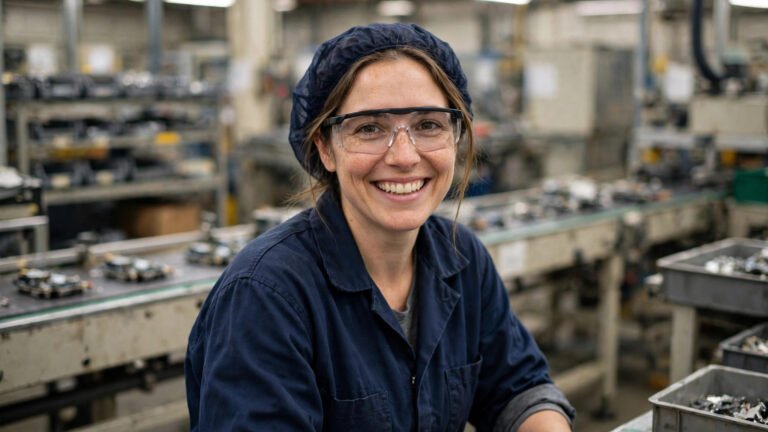
A typical shift usually starts with a short briefing. A supervisor explains the production targets for the day, any changes to the plan, safety reminders and which line or station each person will work on. Workers then collect their protective equipment, such as safety shoes, gloves, ear protection, safety glasses and a hairnet or apron where required, and head to their assigned area.
The first part of the shift is often spent setting up machines, checking materials and starting production. Once the line is running, workers follow a steady rhythm: loading materials, operating machines, assembling parts, checking quality and packing finished products. The pace can be fast, especially when orders are urgent or production targets are high. Teamwork matters, because if one station slows down, the whole line can be affected.
Breaks are scheduled through the shift, and most factories run on a schedule that includes day, evening and night shifts, including weekend work. The exact pattern depends on the employer and the needs of production. Some workers prefer nights because the factory is quieter, while others prefer days because it fits family life better. Flexibility is often expected, especially in busy periods.
Toward the end of a shift, workers clean their work area, complete simple production records, report faults or shortages, and hand over to the next team. The work is repetitive in some ways, but products, orders and production schedules change constantly. People who do well in factory work are usually those who can keep a steady pace, stay focused, work safely and help their team when a colleague is under pressure.
Why Canadian Factories Need Workers
Canada has a diverse manufacturing sector, with factories producing food, drink, wood products, paper, chemicals, plastics, metals, machinery, vehicles and consumer goods. These factories supply shops, construction sites, farms and other businesses across Canada and for export. Keeping production running requires a large and reliable workforce.
Many factories find it difficult to fill roles, especially for evening, night and weekend shifts, and in areas where the local labour pool is small. The work is physical, the hours can be unsocial, and some people prefer other types of work. Turnover can be high, and employers often hire on an ongoing basis. This creates opportunities for international workers who are willing to work shifts, learn new processes and stay with an employer for a longer period.
Some factories and manufacturing companies are able to sponsor overseas workers for roles that meet the immigration requirements. This does not mean every factory job offers sponsorship. Many factory roles are filled locally and are not sponsored, so overseas applicants need to focus on employers who are able to sponsor and who state that sponsorship may be available.
Demand varies by industry and location. Food processing plants often have steadier year round demand, while other factories may be busier at certain times of year. Provinces with large manufacturing bases, such as Ontario and Quebec, often have more vacancies, while smaller towns may have fewer but still need workers. Understanding where demand is strongest can help you target your applications.
Who Does Well in This Role
Factory work suits people who like practical, structured work and do not want to sit at a desk all day. If you enjoy working with your hands, following a clear process, operating machines and seeing a finished product, you may find factory work satisfying. It also suits people who are comfortable working as part of a team on a production line, where each person contribution matters.
Physical fitness matters. You will be on your feet for most of the shift, standing, bending, lifting and carrying materials and products. You do not need to be an athlete, but you should be comfortable with regular physical activity and able to lift and move goods safely. Employers provide manual handling and safety training, and following that training protects you and your colleagues from injury.
Attention to detail is another important quality. Making a mistake in assembly, missing a defect in quality checking, or labelling a product incorrectly can cause delays, waste and unhappy customers. Workers who check their work, follow instructions carefully and ask when something is unclear tend to do well and are trusted with more responsibility over time.
Reliability is highly valued. Factories run to tight production schedules, and if a team member does not turn up, the rest of the team has to cover the gap and production can fall behind. Being on time, communicating early if you have a problem, and completing your tasks without needing constant supervision will make a strong impression on supervisors and can lead to better shifts, training opportunities and longer term work.
Basic English is important for safety and teamwork, and in some parts of Canada, French is also useful. You need to understand instructions, read safety signs and labels, complete simple records and communicate with colleagues and supervisors. You do not need perfect English to start, but you should be able to understand and be understood in everyday work situations. Improving your language skills before you apply will help you in interviews and on the job.
What You Need Before You Apply
Requirements vary by factory and role, but most factory jobs share a similar baseline. The list below gives a general idea of what employers and the immigration process usually expect. Always read the specific job advertisement, because that is the authoritative source for that role.
To begin with, a Canadian factory will expect you to be of working age and eligible for a work permit under a route such as the Temporary Foreign Worker Program. Your passport needs plenty of validity left on it, and you should be ready to hand over whatever the factory and Immigration, Refugees and Citizenship Canada ask to see. That usually means your passport, records of your schooling or previous factory, warehouse or production jobs, and evidence of your English or French ability when the role or the permit route calls for it.
Second, most employers ask for a basic level of education and the ability to read, write and follow instructions in English, and in French where relevant. Previous factory, warehouse, manufacturing or physical work experience is helpful and often preferred, but many factories will consider applicants without direct experience if they show the right attitude, physical fitness and willingness to learn. Experience in any role that involved operating machines, assembling products, checking quality or working on a production line can be useful to mention.
Third, you will need to be able to pass any checks the employer requires. These may include a right to work check, references from previous employers, and in some roles a basic background check. If the job involves operating forklifts or other equipment, you will need the relevant licence or training, although many employers provide training after you start.
Your resume also needs to be short, clear and completely honest. Put your contact details at the top, then your work history in reverse order, your education, your practical skills and any training you have done. Mention machine operation, assembly, packing or quality checking if you have done it, and keep the layout plain so a hiring manager can scan it in seconds. Do not stretch the truth about your experience, because a Canadian plant may phone your referees and will quickly see during induction whether you can actually run the line you claimed to know.
Last of all, get yourself ready for the immigration side of the move. That normally means an application to the Canadian government, a set of supporting papers, and possibly a biometrics appointment or an interview at a visa office. What exactly is asked for depends on the permit route and the rules on the day you apply, so read the official guidance for your route rather than copying what worked for someone else. Steer clear of any agent who promises a guaranteed visa or a guaranteed factory job, and photocopy or scan every document you send in.
Applying From Abroad: The Steps That Work
Applying for a factory job with visa sponsorship in Canada takes patience and organisation. The steps below describe a sensible approach that many successful applicants follow.
Start by researching factories and manufacturing companies that hire international workers. Large food processing companies, manufacturers and industrial employers often have information on their careers pages about international hiring. Make a shortlist of employers whose locations, products, shift patterns and roles match what you are looking for.
After that, look for live openings on the careers pages of Canadian food processors, packaging plants and manufacturers, and on trusted job boards such as Job Bank. Read every advert from top to bottom. Note the job title, the town or province, the shift pattern, the duties, the requirements and whether the advert mentions sponsorship. When sponsorship is not mentioned, do not take it for granted. You can still put your name forward, but be upfront about needing sponsorship and ask politely whether the plant would consider it for the right candidate.
Prepare your resume and a short cover note for each application. Tailor the cover note to the role. Mention any factory, warehouse, manufacturing or physical work experience, your ability to work shifts, your language skills and your interest in the employer. Keep the tone professional and honest. Avoid sending the same generic message to every employer without any change.
Send your application through the route the advert actually names, which is usually an online form on the employer’s site or an email to the hiring team. Keep a simple log of each application you make, with the date, the company name, the role and any reference number from the advert. That log stops you from applying twice for the same production-line post and makes it easy to follow up politely if a few weeks pass without a reply.
If you are shortlisted, you may be invited to an online interview, a telephone interview or an assessment. Prepare by learning about the employer and its products, thinking about examples from your past work that show reliability, teamwork and attention to detail, and preparing questions about the role, the shift pattern and the training provided. Dress neatly for a video interview, find a quiet place, and test your connection in advance.
When a factory offers you a role and sponsorship is part of the deal, the employer should walk you through the next steps, including the paperwork for your work permit. Go through the offer letter slowly before you say yes. Check the job title, the plant location, the shift hours, how pay is structured, the start date and any conditions attached to the offer. If a line is unclear, ask for it to be explained in writing before you put your signature on anything.
With the sponsorship documents in hand, you can put your immigration application together. Collect your passport, the employer’s papers and any supporting evidence, fill in the forms carefully, and follow the official instructions for submitting them. Keep a copy of every page. Once it is sent, you may be asked to give biometrics or to supply extra information, so answer quickly and truthfully and keep the employer’s contact details close in case the visa office has questions.
Sponsorship Explained: What Factory Worker Applicants Should Know
Sponsorship in Canada is widely misunderstood, so it helps to be precise about what it is and what it is not. It is not a promise of a job, and it is not a promise of a work permit or visa. It is a process in which a Canadian factory backs your application for one named role, usually by supplying a job offer and the supporting documents the immigration system asks for, such as a Labour Market Impact Assessment where that route requires one.
For that backing to work, three things have to line up. The factory must be able and willing to complete its side of the process, the production role has to fit the requirements of the permit route, and the Canadian government must approve the application and issue the work permit. The decision depends on the rules in force, the papers you submit and your own circumstances. An employer can support you, but only the government can grant the permit.
Sponsorship also does not mean the factory pays for every part of the move. Some Canadian manufacturers cover certain costs, such as the employer’s own application steps, while others expect the worker to handle immigration and travel costs themselves. The split changes from one employer to another, so it should be spelled out in the offer or in writing before you accept. Always ask which costs fall to you, and never hand over a large sum to a middleman who claims he can arrange sponsorship for you.
Remember too that sponsorship is normally linked to one employer and one role. If you later want to move to a different factory or a different job, you may need fresh sponsorship and a new work permit application. That is how the Canadian system works, so it is worth thinking hard before you accept: is the plant location right, are the shifts workable, and do the terms suit you for the length of the contract?
Immigration rules do not stand still. The roles that qualify, the wage conditions, the language expectations and the application steps can all be updated, and a route that was open last year may look different when you apply. For that reason, always check the current rules on the official Canadian immigration website at the time you apply, rather than trusting old posts online or a friend’s experience from a different year. If factory worker jobs in Canada are not the right fit, hotel worker jobs in Canada follow a similar sponsorship route.
Watch out for scams as you search. A real Canadian factory will not ask you to pay for a job offer, will not guarantee you a visa, and will not push you to send money in a hurry. If an offer looks too good to be true, if the company cannot be found online, or if you are asked to pay through an unusual channel, stop and get advice. You can check a vacancy against the employer’s official website and, if you need it, speak to a qualified immigration consultant. If factory worker jobs in Canada are not the right fit, cleaner jobs in Canada follow a similar sponsorship route.
Seasonal Peaks and Steady Work
Demand for Factory Workers in Canada rises and falls with the season: harvest time on farms, holiday peaks in warehouses, and production runs in factories. Some contracts are seasonal and end when the peak passes, while others continue year-round. Check whether the offer is seasonal or permanent, and what happens when the busy period ends.
Daily Life in Canada for Factory Workers
Moving to Canada for factory work means adjusting to a new country, climate, culture and way of working. Canada is very large, with many provinces, cities, towns and rural areas, and a wide range of communities and climates. Factory jobs are found across the country, from large industrial areas in cities to food processing plants in smaller towns and rural areas.
The climate varies greatly by region and season. Winters can be very cold, with snow in many areas, while summers are usually warm and pleasant. Factories are indoors, but you may need to travel to work in cold weather and work in areas where the temperature varies, such as cold storage or hot production areas. Suitable clothing, a good coat, warm layers and comfortable shoes will help you stay comfortable.
Day to day life after arrival is full of practical tasks: finding a place to live, opening a Canadian bank account, understanding provincial healthcare, sorting out a driving licence if you need one, learning the bus or train routes near the plant, and keeping your spending under control. Many newcomers share a house or apartment at first to keep rent down and pick somewhere close to the factory or a transit stop. It pays to research the town before you land, work out what rent, food and travel will cost, and plan your first few weeks in detail.
Workplace culture in Canada values politeness, punctuality, teamwork, safety and respect for diversity. Supervisors expect workers to follow instructions, raise problems early, and treat colleagues with courtesy. Learning the norms of your workplace, asking questions when you are unsure, and building good relationships with colleagues will help you settle in.
Away from the production line, Canada has plenty to discover, from busy cities and national parks to lakes, mountains, festivals and food from almost every culture. Many factory towns have international grocery stores, places of worship and community groups that help newcomers settle in. Making friends, joining a local activity and keeping a regular call time with family back home can make the first few months much easier, especially through a long Canadian winter.
Common Mistakes Factory Worker Applicants Make
Many applications fail for avoidable reasons. The first mistake is applying for every factory job without checking whether the employer can sponsor or whether sponsorship is available. This wastes time and leads to disappointment. Focus on employers who can sponsor and roles that match your experience.
A second common error is sending in a weak resume. Spelling mistakes, missing dates, unexplained gaps and claims that do not add up will put a hiring manager off before you ever reach an interview. Spend real time on your factory resume, check it line by line, and ask someone you trust to read it through. A clean, honest resume that lists your production experience clearly will always beat a flashy one full of errors.
A third error is walking into a scam. If someone offers you a guaranteed factory job and visa in return for a large payment, asks you to pay through an unusual method, or cannot show you verifiable details about the employer, treat it as a warning sign. Real recruitment in Canada does not work that way, and a genuine factory will never ask you to buy your job.
A fourth error is turning up to the interview unprepared. Candidates who know nothing about the plant, cannot say why they want the production role, or cannot give a single example from their past work rarely get hired. Learn about the company and its products, practise answers about your experience on a line or with machines, and show that you genuinely want the job.
A fifth error is misunderstanding how the immigration process works. Some applicants think a job offer on its own is enough, or that sponsorship guarantees a work permit. Others send in incomplete documents or miss a deadline. Read the official guidance for your permit route, follow each instruction, and keep a copy of everything you submit so nothing gets lost.
A sixth error is arriving in Canada with no preparation at all. Some workers land without enough savings for the first few weeks, without a place to stay, or without any idea of the climate and the cost of living in their province. Saving what you can, arranging short term housing in advance and researching your destination will make the first month far smoother, especially if you arrive in winter.
Earnings, Hours and Conditions
Pay for factory work in Canada varies by employer, location, industry, shift and experience. Some roles pay more for evening, night or weekend work, while others offer a standard rate with additional allowances. It is not possible to give a single figure that applies to every factory job, and any article that does so should be treated with caution. When you read a job advertisement, look for how pay is described, whether it is hourly or salaried, what shift allowances apply, and what benefits are included.
Hours also vary. Many factories operate on rotating shifts, and full time roles often involve a set number of hours per week spread across days, evenings, nights or weekends. Part time roles may be available in some factories. Overtime may be offered during busy periods, but it is not guaranteed. Your offer letter should state your working hours, break entitlements, paid time off and notice period. Read it carefully before you sign.
Working conditions in modern factories are generally well organised, with health and safety rules, protective equipment and training. You will be expected to wear safety shoes and other protective equipment, follow safe operating procedures, report hazards and use machines only after training. The work can be tiring, especially in noisy, hot or cold areas or during long shifts, so it helps to look after your health, eat well, stay hydrated and get enough rest between shifts.
Benefits vary by employer. Some offer health benefits, retirement contributions, paid time off, training and opportunities to progress into team lead, quality control or supervisor roles. Others offer a more basic package. When you compare offers, look beyond the headline pay and consider the full package, the stability of the work, the location and the cost of living in that area.
Common Questions About Factory Worker Jobs in Canada
Can I get a Canada factory job with visa sponsorship if I have no experience
Many factories consider applicants without direct factory experience, especially for entry level roles such as general labourer, packer or production helper, if they show reliability, physical fitness and willingness to learn. Previous experience in warehouse, manufacturing, construction or other physical work can help, but it is not always required. Training is often provided after you start.
Do I need to speak fluent English to work in a Canadian factory
You do not need perfect English, but you do need enough English to understand safety instructions, read labels and signs, follow production instructions and communicate with colleagues. In some parts of Canada, French is also useful. Improving your language skills before you apply will help you in interviews and in the job itself.
How long does the application process take?
The time from applying to starting work on a Canadian production line varies a great deal. It depends on how fast the factory moves through hiring, how quickly the sponsorship paperwork is finished, and how long the government needs to process the work permit. Some cases move along steadily, while others stretch over many months, particularly when extra checks are needed. Give yourself plenty of time and do not book flights until your work permit is actually granted.
Will the employer provide housing?
Some Canadian factories help with housing or point workers toward local options, but many do not provide a place to live directly. Always look at the job advert and the offer letter for the exact wording. Never assume a room or apartment is included unless it is written down in the offer.
Can I bring my family with me?
Whether family members can travel with you depends on the permit route and the rules in force when you apply. Some routes allow dependants to join the worker, while others carry conditions or limits. Check the official guidance for your own route and take professional advice if you are unsure.
What happens if my work permit application is refused?
A refusal does not automatically close the door forever, but you need to understand the reason before you try again. Read the refusal letter carefully, fix the problems it points out, and think about speaking to a qualified immigration consultant. Do not pay an agent who promises to overturn a refusal for a fee without explaining how the process actually works.
Where to Go From Here
Canada factory worker jobs with visa sponsorship in 2026 can be a practical option for international workers who want steady, hands on work in Canada. The role is physical and demanding, but it offers clear routines, teamwork and the chance to build experience in manufacturing, one of Canada important sectors. For the right person, it can be a solid first step into life and work in Canada, with opportunities to learn new skills and progress over time.
Doing well in this pathway comes down to preparation. Aim for factories that genuinely can sponsor, write a clear and honest application, practise for the interview, learn how the Canadian immigration process works and plan your move step by step. Keep in mind that sponsorship is never guaranteed: it depends on the employer, the production role and a government decision, and the rules can change. By staying informed, sticking to genuine employers and refusing shortcuts or scams, you give yourself the strongest chance of success.
If factory work appeals to you, start by researching employers, improving your language skills, gathering your documents and building a strong application. Take it one step at a time, keep records of your progress, and seek advice from official sources when you need it. With patience and realistic expectations, you can make a well informed decision about whether this path is right for you.