Top 15 Animals That Live in the Desert
Introduction
Top 15 Animals That Live in the Desert is a list that changes the way most people think about the desert, because a desert looks empty from a distance and yet it is full of life. Deserts cover about one fifth of the land on Earth, from the Sahara in Africa to the deserts of Australia, Arabia, North America and Asia, and they are among the hardest places on the planet to live. The sun is fierce, the rain is rare, the nights are cold, and water can be hundreds of kilometres away. Yet animals have found ways to survive here that are more clever than almost anywhere else on Earth. This article counts down fifteen of them, explains how each one beats the heat, finds water and avoids predators, and finishes with the patterns that tie these desert survivors together. Whether you are a student, a nature lover, or just curious about how life endures in the driest places on Earth, this list shows that the desert is not empty at all.
Desert animals do not survive by being tough in the ordinary sense. They survive by being clever. Some never drink water at all, making it inside their bodies from the food they eat. Some sleep through the hottest months in a deep underground burrow. Some hunt only at night, when the sand is cool, and some have bodies that cool themselves in ways that seem impossible, such as the camel, which can let its body temperature rise and fall like a thermostat. The fifteen animals on this list use all of these tricks and more, and each one is a master of its own desert.
1. Fennec Fox
The fennec fox is the smallest fox in the world and one of the most charming animals in the Sahara, with ears so large they look too big for its body. Fennec foxes weigh only about one kilogram and stand about twenty centimetres tall at the shoulder, with a sandy coloured coat, a bushy tail and ears that can be fifteen centimetres long. Those ears are not just for hearing. They are full of blood vessels that release heat and help the fox stay cool, and they can hear a beetle moving underground or a lizard rustling in the sand from a long way off. Fennec foxes live in the Sahara and the deserts of North Africa and the Arabian Peninsula, where they dig deep burrows with several entrances in the sand. They are nocturnal, which means they hunt at night when the desert is cool, and they eat rodents, birds, eggs, reptiles and insects, digging them out of the sand with their sharp claws. Their feet are covered in thick fur, which protects them from the hot sand and helps them run across loose dunes without sinking. Fennec foxes can go for a long time without drinking water, because they get most of the moisture they need from their food, and their kidneys are so efficient that they waste almost no water at all. They live in family groups, and both parents care for the pups, which are born in the burrow and stay there for the first weeks of life. The fennec fox is a desert specialist in every way, from its ears to its feet to its kidneys.
2. Camel
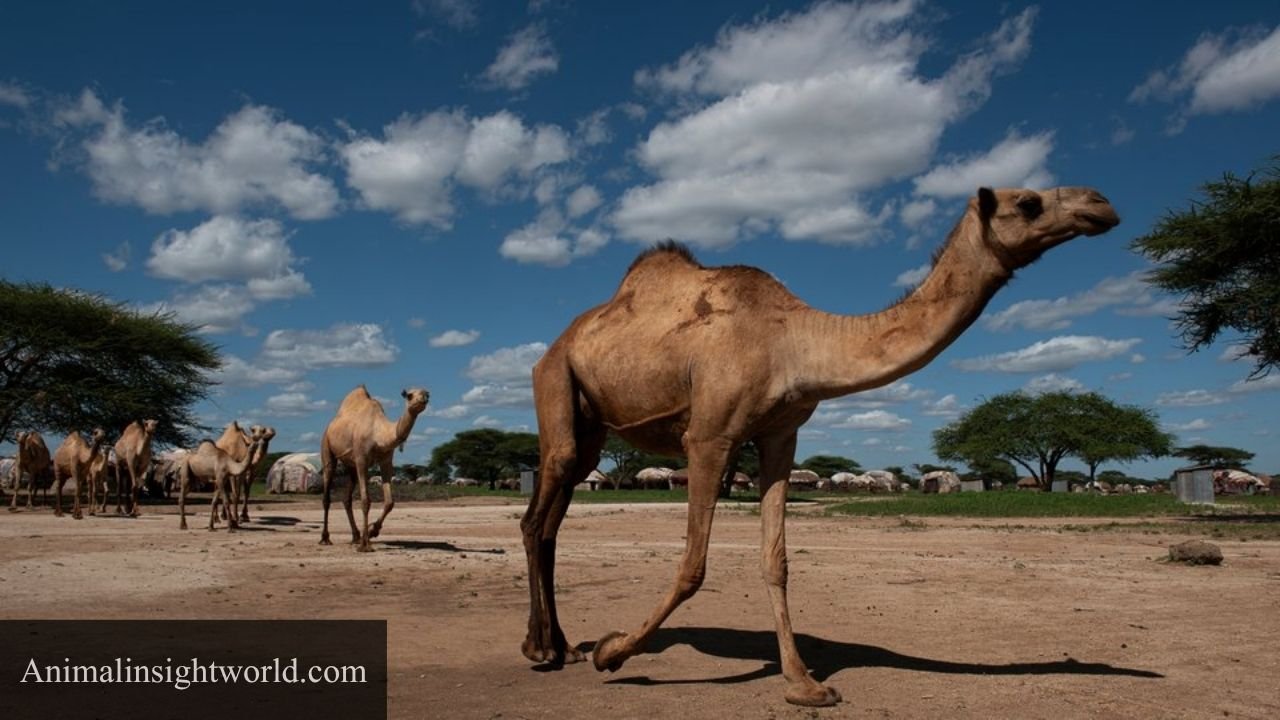
The camel is the most famous desert animal in the world, and it deserves its reputation as the ship of the desert. There are two main kinds of camel. The dromedary camel has one hump and lives in the deserts of North Africa and the Middle East, while the Bactrian camel has two humps and lives in the cold deserts of Central Asia. A large camel can stand more than two metres tall and weigh up to seven hundred kilograms, and it can carry heavy loads across the desert for days. The hump is not full of water, as many people believe. It is full of fat, which the camel can turn into energy and water when food and drink are scarce. Camels can drink more than one hundred litres of water in ten minutes when they find it, and they can then go for days or even weeks without drinking again. Their bodies are built for the desert in other ways too. They have long eyelashes and nostrils that close to keep out sand, wide feet that spread their weight on soft sand, and thick lips that let them eat thorny desert plants. Camels can let their body temperature rise by several degrees during the day and fall again at night, which saves water that would otherwise be lost through sweating. They have been used by people for transport, milk, meat and wool for thousands of years, and without the camel, trade across the great deserts would have been impossible. The camel is not just a survivor, it is the animal that made desert life possible for humans.
3. Gila Monster
The Gila monster is a slow, heavy lizard of the deserts of the southwestern United States and northwestern Mexico, and it is one of only a few venomous lizards in the world. Gila monsters grow to about fifty centimetres long and weigh up to two kilograms, with a thick body covered in bead like scales of pink, orange and black that warn predators to stay away. They spend most of their lives underground in burrows or under rocks, coming out in spring and early summer to hunt for eggs, young birds, small mammals and insects. A Gila monster can eat a meal that is one third of its own body weight, and then it may not eat again for months, because it stores fat in its tail and in its body like a camel stores fat in its hump. Their venom is not usually deadly to people, but a bite is very painful, and the lizard holds on tightly and chews, working the venom into the wound. Gila monsters are protected by law in the United States, because they are slow, rare and often killed by people who fear them, even though they are shy and will only bite if handled. They are most active in the morning and evening, avoiding the heat of the day, and they can live for more than twenty years in the wild. The Gila monster is a reminder that the desert has its own rules, and that a slow, brightly coloured lizard can be one of its most successful animals.
4. Kangaroo Rat
The kangaroo rat is a small rodent of the deserts of North America that never drinks water at all, and it is one of the most perfectly adapted desert animals on Earth. Kangaroo rats grow to about ten to fifteen centimetres long with a long tail, and they have large hind legs that let them hop like a tiny kangaroo, which is how they got their name. They live in the deserts of the southwestern United States and Mexico, where they dig burrow systems in sandy soil and come out at night to collect seeds, which they carry back to their burrows in fur lined cheek pouches. The amazing thing about kangaroo rats is that they make their own water. They get all the water they need from the dry seeds they eat, because their bodies produce water as they break down the food, and their kidneys are so efficient that they produce almost no urine. They also lose very little water through breathing, because their burrows are cool and humid, and they plug the entrances during the day to keep the moisture in. Kangaroo rats can survive in places where the temperature reaches fifty degrees, and they are an important food for owls, snakes, coyotes and other desert predators. They are also important seed dispersers, because the seeds they bury and forget can grow into new plants. A kangaroo rat that never drinks a drop of water in its whole life is one of the desert’s greatest tricks.
5. Thorny Devil
The thorny devil is a small, spiky lizard of the deserts of Australia, and it looks like a tiny dragon that has wandered out of a storybook. Thorny devils grow to about twenty centimetres long, with a body covered in sharp spines, a large spiny head, and a false head on the back of the neck that confuses predators. Their colour changes with the temperature and the time of day, from pale yellow in the morning to dark brown in the heat, which helps them blend into the red sand and the spinifex grass where they live. Thorny devils eat almost nothing but ants, and they can eat thousands of ants in a single day, licking them up with a sticky tongue as they walk slowly along an ant trail. They have a special trick for finding water. Tiny grooves between their scales carry water from any part of their body to their mouth by capillary action, so a thorny devil that stands in a damp patch of sand or in morning dew can drink through its skin. Their spines protect them from predators, and when threatened they tuck their real head down and show the false head instead, which makes them look bigger and harder to eat. Thorny devils move slowly and deliberately, and they can live for twenty years in the wild. They are harmless to people and are one of the most loved lizards in Australia, a perfect example of how the desert rewards strange and beautiful solutions.
6. Sand Cat
The sand cat is a small, shy wild cat of the deserts of North Africa, the Middle East and Central Asia, and it is one of the most elusive animals in the desert. Sand cats are about the size of a house cat, weighing two to three kilograms, with a sandy coloured coat, a broad flat head, large ears set low on the sides of the head, and fur covered feet that leave almost no tracks in the sand. They live in stony and sandy deserts where few other cats can survive, and they are mostly nocturnal, hunting at night for gerbils, small birds, reptiles and insects. Sand cats are excellent diggers and can dig a burrow quickly to escape the heat or to catch a rodent hiding underground, and they are so quiet and so well camouflaged that researchers often struggle to find them even with radio collars. They get most of their water from their prey and can go for long periods without drinking, and they can survive temperatures that would kill a domestic cat. Sand cats are solitary animals that only meet to mate, and the mother raises her kittens alone in a burrow or a rock crevice. Their numbers are falling in some places because of habitat loss and hunting, and they are now protected in many countries. The sand cat is a reminder that the desert has its own wild cats, and that they are just as skilled as the lions and tigers of the savanna, only smaller and much harder to see.
7. Jerboa
The jerboa is a tiny, long legged rodent of the deserts of North Africa and Asia, and it looks like a miniature kangaroo with a mouse sized body and a very long tail. Jerboas grow to about ten centimetres long with a tail that can be twice as long as the body, and they have huge hind legs, tiny front legs, large ears and big dark eyes for seeing at night. They live in the sandy and stony deserts from Morocco to Mongolia, where they dig burrows with several entrances and a deep nesting chamber that stays cool during the day. Jerboas are nocturnal, coming out at night to hop across the sand in search of seeds, roots, insects and green plants, and they can leap more than a metre in a single bound, zigzagging to escape owls and foxes. Like kangaroo rats, jerboas get most of their water from their food and can go for long periods without drinking, and their kidneys are highly efficient at saving water. Some jerboa species hibernate in winter, sleeping for months in their burrows, while others stay active all year round. Their long tails help them balance when they hop and turn in mid air, and their large ears help them hear predators approaching in the dark. Jerboas are gentle, harmless animals that are an important food for desert owls and snakes, and they are also important seed dispersers. Watching a jerboa hop across the moonlit sand is one of the desert’s most charming sights, a tiny kangaroo in a world of sand and stars.
8. Sidewinder
The sidewinder is a rattlesnake of the deserts of the southwestern United States and northwestern Mexico, and it moves in one of the strangest ways of any snake on Earth. Instead of sliding forward in a straight line, the sidewinder lifts loops of its body sideways across the sand, leaving a trail of J shaped tracks, which is how it got its name. Sidewinders grow to about sixty to eighty centimetres long, with a sandy coloured body marked with dark patches, a triangular head and a small rattle on the tail. The sideways movement is a clever solution to the problem of hot sand, because only two parts of the body touch the ground at any moment, which keeps the snake cool and stops it sinking into loose sand. Sidewinders are nocturnal during the hot summer, hunting at night for kangaroo rats, lizards and small birds, and they are ambush hunters that bury themselves in the sand with only their eyes and the tip of the tail showing, waiting for prey to come close. They are venomous, but their venom is mainly for killing prey, and they are shy snakes that would rather flee than bite a person. Sidewinders can go for months without food, and they get most of their water from the animals they eat. They shed their skins several times a year, and each shed adds a new segment to the rattle. The sidewinder is a perfect desert machine, with a body, a movement and a hunting style that are all shaped by sand and heat.
9. Oryx
The oryx is a large, elegant antelope of the deserts of Africa and Arabia, and it is one of the few large animals that can live in a true desert without needing to drink every day. There are several kinds of oryx, including the Arabian oryx, the gemsbok of southern Africa and the scimitar horned oryx of the Sahara, and all of them share long, straight horns, a pale coat and a remarkable ability to survive heat. Oryx grow to about one hundred and twenty centimetres tall at the shoulder and weigh up to two hundred kilograms, with a white or sandy coat, dark markings on the face and legs, and horns that can be more than a metre long in both males and females. They live in open deserts and dry grasslands, where they feed on grasses, leaves, roots and wild melons, and they can go for weeks without drinking water, getting moisture from the plants they eat and from dew. Oryx have a special cooling system in their blood vessels that cools the blood on its way to the brain, which lets them survive body temperatures that would kill most other mammals. They are also able to detect rain from a long distance away and will travel many kilometres towards a distant storm. The Arabian oryx was once extinct in the wild and was saved by a captive breeding programme, and it is now one of the great success stories of conservation, with herds roaming free again in Oman, Saudi Arabia and the United Arab Emirates. The oryx is a symbol of the desert itself, graceful, tough and able to live where almost nothing else can.
10. Meerkat
The meerkat is a small, social mongoose of the deserts of southern Africa, and it is one of the most watched and most loved desert animals in the world. Meerkats grow to about thirty centimetres long with a long tail and weigh less than one kilogram, with a sandy coat marked with dark bands across the back, dark patches around the eyes and a slender body built for digging. They live in the Kalahari Desert and other dry parts of Botswana, Namibia and South Africa, where they dig large burrow systems with many entrances and share them in family groups of up to thirty animals. Meerkats are famous for their lookout behaviour. One meerkat stands upright on its hind legs on a mound or a rock and scans the sky and the horizon for eagles, jackals and snakes, while the others forage for insects, scorpions, lizards, eggs and small rodents. When the lookout spots danger it gives a sharp bark that sends the whole group diving into the burrows. Meerkats take turns as lookouts, and they also take turns babysitting the pups, which are born in the burrow and stay there for the first weeks of life. They are active during the day, warming up in the morning sun before starting to forage, and they huddle together at night for warmth. Meerkats are not endangered, but they depend on open desert and grassland, and they are a delight to watch as they stand upright and scan the horizon like tiny desert sentries.
11. Desert Tortoise
The desert tortoise is a slow, gentle reptile of the deserts of the southwestern United States and northwestern Mexico, and it is one of the longest lived animals in the desert. Desert tortoises grow to about thirty five centimetres long and weigh up to seven kilograms, with a high domed shell that is brown or grey and strong legs with sharp claws for digging. They live in the Mojave and Sonoran deserts, where they dig burrows up to ten metres long in the sandy soil, and these burrows are vital for survival, because they stay cool in summer and warm in winter and protect the tortoise from predators. Desert tortoises spend most of their lives underground, coming out in spring and autumn to feed on grasses, wildflowers, cactus pads and fruit, and they can store water in their bodies for months. They are most active in the morning and evening, avoiding the heat of the day, and they hibernate in their burrows during the winter. Female desert tortoises lay their eggs in a nest dug near the burrow entrance, and the eggs hatch after several months, with the babies facing many dangers from ravens, coyotes and other predators. Desert tortoises can live for fifty to eighty years, but their numbers are falling because of habitat loss, disease, road deaths and collection as pets, and they are now protected by law. The desert tortoise is a reminder that slow and steady really does win in the desert, as long as the burrow and the habitat survive.
12. Horned Viper
The horned viper is a venomous snake of the deserts of North Africa and the Middle East, and it is named for the small, horn like scale above each eye that gives it a fierce, devilish look. Horned vipers grow to about fifty to eighty centimetres long, with a thick body, a sandy or grey colour marked with dark spots, and a short tail. They live in sandy deserts, where they bury themselves in the sand with only their eyes and horns showing, waiting for lizards, small birds and rodents to come within striking distance. Like the sidewinder, horned vipers can move sideways across loose sand, which keeps them cool and stops them sinking, and they are mostly nocturnal, hunting at night when the desert is cool. Their venom is powerful and is used to kill prey quickly, and a bite is dangerous to people, so these snakes should be given plenty of space. Horned vipers are also known for a strange habit. They sometimes use the tip of their tail as a lure, wiggling it like a worm to attract lizards, which come closer to investigate and are then caught. They can go for long periods without food, and they get most of their water from the animals they eat. Horned vipers are an important part of the desert food web, controlling rodent and lizard numbers, and they are respected by desert peoples who know how to read their tracks in the sand. The horns above the eyes may look like decoration, but they help to shade the eyes from the sun and to break up the outline of the head in the sand.
13. Bilby
The bilby is a small, long eared marsupial of the deserts of Australia, and it is one of the most charming and most endangered animals in the Australian outback. Bilbies grow to about thirty to fifty centimetres long with a long tail and weigh one to two kilograms, with soft blue grey fur, a white belly, a long pointed nose and ears that can be ten centimetres long. They live in the sandy deserts and spinifex grasslands of central and western Australia, where they dig deep burrows with a characteristic spiral shape that helps keep them cool and safe from predators. Bilbies are nocturnal, coming out at night to dig for insects, larvae, seeds, bulbs and fungi, and their strong front claws and long nose make them excellent diggers. They get most of their water from their food and can go for long periods without drinking, and they are solitary animals that only meet to mate. The female carries her babies in a pouch that opens backwards, which stops sand getting in while she digs, a clever adaptation that no other marsupial shares in quite the same way. Bilbies were once common across most of Australia, but their numbers have fallen sharply because of introduced foxes and cats, which hunt them, and because of rabbits, which compete for their food and damage their habitat. Conservationists now protect bilbies in fenced reserves and predator free areas, and they have become a symbol of Australian wildlife, with chocolate bilbies sold at Easter instead of chocolate bunnies to raise money for their protection. The bilby is a reminder that the Australian desert has its own unique animals, and that they are worth saving.
14. Roadrunner
The roadrunner is a fast, ground dwelling bird of the deserts of the southwestern United States and Mexico, and it is far more real and far more interesting than the cartoon character it inspired. Greater roadrunners grow to about fifty five centimetres long with a long tail and weigh about three hundred grams, with a streaked brown and white body, a crest on the head, a long bill and strong legs built for running. They live in desert scrub, open woodland and dry grassland, where they prefer to run rather than fly, and they can reach speeds of more than thirty kilometres per hour on the ground. Roadrunners eat almost anything they can catch, including lizards, snakes, small birds, rodents and insects, and they are one of the few animals that regularly hunt and eat rattlesnakes, working in pairs to distract the snake and then grabbing it by the head. They are active during the day, which is unusual for a desert bird, and they warm up in the morning by turning their backs to the sun and raising the feathers to let the heat reach their skin. Roadrunners can survive without drinking water, getting moisture from their prey, and they have special glands that remove salt from their bodies, which lets them eat salty foods that other birds cannot. They build a nest of sticks in a cactus or a thorny bush, and both parents care for the chicks. The roadrunner is a true desert bird, fast, bold and perfectly suited to a life on the ground in the heat.
15. Deathstalker Scorpion
The deathstalker scorpion is a small, pale yellow scorpion of the deserts of North Africa and the Middle East, and it is one of the most venomous scorpions in the world. Deathstalkers grow to about five to eight centimetres long, with a yellow body, long thin pincers and a tail that curves over the back and ends in a sharp stinger. They live in the Sahara and the deserts of Arabia, Israel and Egypt, where they hide under rocks and in burrows during the day and come out at night to hunt for insects, spiders and other scorpions. Their venom is a powerful mix of toxins that can be dangerous to people, especially children, and a sting is very painful, so these scorpions should be treated with respect and left alone. Deathstalkers are also important to science, because their venom contains a substance that researchers are studying as a possible treatment for brain tumours, and a drug based on their venom is being tested in hospitals. They are agile and fast, and they can climb rocks and walls, which is why they sometimes turn up in houses in desert towns. Deathstalkers can go for months without food, and they get most of their water from their prey. They are solitary animals that only meet to mate, and the female carries her babies on her back until they are old enough to hunt alone. The deathstalker scorpion is a reminder that the desert is full of animals that demand respect, and that even the smallest and most feared creatures can hold secrets that help people.
Where They Live and How They Survive
The fifteen animals on this list live in deserts on five continents, from the Sahara and the Kalahari in Africa to the Mojave and Sonoran deserts of North America, the Arabian Desert, the deserts of Central Asia and the great red deserts of Australia. What ties them together is not where they live, but how they live. Almost all of them are active at night or at dawn and dusk, when the desert is cool, and almost all of them get most of their water from food rather than from drinking. The kangaroo rat and the jerboa never drink at all, the camel can go for weeks without water, and the oryx can go for weeks as well, while the thorny devil drinks through its skin and the sand cat gets its water from the rodents it hunts.
Burrows are the second great desert trick. The fennec fox, the kangaroo rat, the jerboa, the meerkat, the bilby and the desert tortoise all live underground for much of their lives, because a burrow stays cool in summer and warm in winter, and it protects them from predators and from the drying wind. Colour is the third trick. Almost every desert animal is sandy, grey or pale yellow, which helps it blend into the sand and the rocks, and many of them, such as the thorny devil and the sidewinder, can change shade with the temperature and the time of day. Speed and stealth are the fourth trick, from the roadrunner sprinting across the scrub to the sidewinder gliding sideways across the dunes. Together, these tricks explain how life thrives in a place that looks lifeless, and they are a lesson in how evolution solves the same problem in many different ways.
Questions People Ask
What is the most common desert animal?
There is no single most common desert animal, because each desert has its own creatures, but rodents such as kangaroo rats, jerboas and gerbils are among the most numerous mammals in most deserts. Reptiles such as lizards and snakes are also very common, and insects such as ants and beetles outnumber everything else. The camel is the most famous desert animal, but it is far from the most common.
How do desert animals survive without water?
Most desert animals get their water from food. Kangaroo rats and jerboas make water inside their bodies as they digest dry seeds, and their kidneys are so efficient that they waste almost no water. Camels and oryx can go for weeks without drinking by storing fat and by letting their body temperature rise and fall. Other animals, such as the thorny devil, collect dew and rain through grooves in their skin. No desert animal can live without water entirely, but they are all experts at saving every drop.
Are desert animals dangerous?
Some are, and most are not. The Gila monster, the horned viper, the sidewinder and the deathstalker scorpion are all venomous and should be given plenty of space, but they are shy animals that would rather flee than bite or sting. The camel, the oryx, the meerkat, the fennec fox and the roadrunner are harmless to people. The rule for any desert animal is simple, watch it from a distance and never try to handle it.
Which desert has the most animals?
The Sahara is the largest hot desert, but the deserts of Australia and the Kalahari are often richer in wildlife, because they have more varied habitats and more regular rain. The Sonoran Desert of North America is one of the most biologically rich deserts in the world, with many species of cactus, birds and mammals. Every desert has its own special animals, and each one is worth protecting.
Can desert animals live anywhere else?
Most desert animals cannot live outside the desert, because their bodies are so specialised for heat, dryness and sandy ground that they struggle in cooler, wetter places. Camels and oryx can live in zoos and on farms in other climates, but animals such as the kangaroo rat, the thorny devil and the bilby need the desert to survive. That is why protecting desert habitats matters, because once a desert is damaged, its animals have nowhere else to go.
Final Thoughts
Top 15 Animals That Live in the Desert proves that the driest places on Earth are full of life, and that life there is more clever than almost anywhere else. From the fennec fox with its enormous ears and the camel that can drink a hundred litres in ten minutes to the kangaroo rat that never drinks at all and the thorny devil that drinks through its skin, these fifteen animals show that survival in the desert is not about being tough, it is about being smart. They hunt at night, sleep underground, save every drop of water, blend into the sand and move in ways that no other animals can. The next time you look at a desert and think it is empty, remember the fox, the camel, the meerkat, the roadrunner and the rest, and remember that the desert is not empty at all. It is full of survivors.